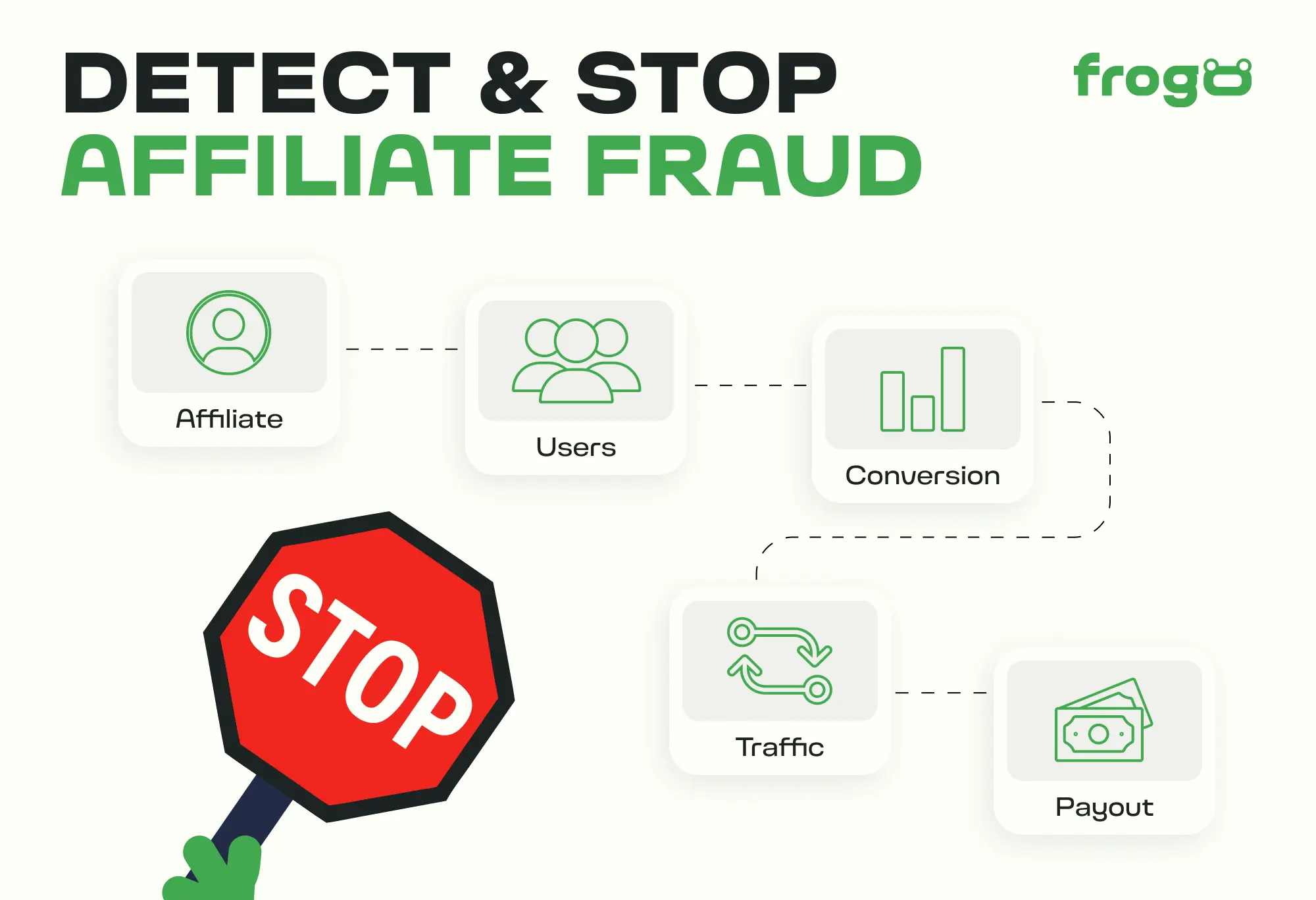
Affiliate Fraud Detection: Your Guide for 2026
In a world where a third of users routinely block traditional ads, affiliate marketing may be the only way to cut through the noise. But while affiliate programs are a net positive that drives customer acquisition and sales, affiliate marketing also has a darker side: fraud.
Estimates vary, but one report estimated fake affiliate traffic at 17.9% in 2023, up from 11.3% in 2022. More recent reports estimate that 18.6% or 21.3% of global desktop and mobile traffic is invalid.
For businesses, affiliate fraud means paying commissions for fake clicks, impressions, sign-ups and fraudulent transactions. It can also mess up the way decisions are made: marketing teams might increase the size of campaigns that seem to be doing well, but not realise that a lot of the “conversions” are fake. This can result in a waste of budget, unreliable measurements, and inaccurate results.
What Is Affiliate Fraud?
Before diving into affiliate fraud detection and prevention, let’s start with a refresher on the affiliate fraud definition. Affiliate fraud is an umbrella term for a variety of malicious tactics fraudsters use to claim commissions from affiliate programs without actually generating genuine activity.
If it goes unchecked, the cost of affiliate marketing fraud can be hefty. For one, you’ll lose part of your marketing budget, lowering the campaign’s ROI. But that’s not the only way fraudulent traffic affects affiliate marketing performance. Fake traffic also contaminates your campaign analytics, making them unreliable for you, your partners, and investors.
You don’t have to spend a lot of time searching for high-profile affiliate fraud cases. Nordstrom was cheated out of $1.4 million in commissions and rebates a decade ago, for example. eBay lost $28 million to two of its super-affiliates. Uber, in turn, reportedly spent $70 million on payouts to fraudsters.
A digital subscription service noticed that traffic from one “top-performing” affiliate had doubled conversions – yet customer lifetime value dropped by 70%. Fraud analysis revealed that 40% of new sign-ups used disposable emails and prepaid cards. The affiliate wasn’t hacking — just buying cheap, short-term traffic.
Frogo tip: Risks associated with affiliate fraud vary by industry. In iGaming, for example, affiliate fraud often overlaps with bonus abuse, so industry-specific schemes should be included in risk assessment.
Frogo Case Study: How One Partner Turned Affiliate Fraud Losses into Profit
A partner approached Frogo during a product demo, reporting a persistent issue with affiliate fraud. After paying commissions to certain affiliates, users would stop engaging with the platform and never return to the platform.
As a result, the business had been operating at a loss for an extended period. Legitimate affiliates were also affected: since all traffic was under suspicion, the partner had to delay affiliate payouts and manually review every affiliate stream. Over the previous six months, total losses exceeded €150,000.
After agreeing on integration, the Frogo analytics team was provided with historical data on affiliates and player activity from the partner’s admin system.
The analysis quickly revealed several clear fraud patterns:
- Abnormal distribution of device types within specific traffic streams
- First deposits being rapidly lost in high-risk games (e.g., roulette or high-stake slots)
- Low variance in first deposit amounts
- A high share of users registered with disposable email addresses
- Consistent use of a single payment method across entire traffic streams
- Repeated top-ups of similar amounts within 15 minutes of the first deposit
- Widespread anomalies in device fingerprints across users
Based on these findings, Frogo implemented targeted triggers and introduced dedicated affiliate monitoring rules tailored to these patterns.
Within just one month, the partner began seeing measurable results. Suspicious traffic streams were automatically flagged via Telegram alerts, allowing the team to quickly review and stop fraudulent traffic before further losses occurred.
As a result:
- Affiliate traffic review time decreased from 30 minutes to just 5 minutes using monitoring rules and the graph forensics tool
- The platform stopped wasting resources on retaining fraudulent users
- The business became profitable for the first time at the end of the month
- Trust improved among legitimate affiliates, as payouts were no longer delayed and traffic was verified quickly
- The partner no longer needed to manually monitor each traffic stream – Frogo handled this automatically
- Previously loss-generating fraud segments were identified and controlled, turning them into a controlled and manageable part of the operation
The key lesson is simple: affiliate fraud often becomes visible only when user quality, payments, device data, and retention are analyzed together.
Common Types of Affiliate Fraud
When you think about this type of fraud, your mind might immediately jump to click fraud in affiliate marketing. However, this is just one tactic in affiliate fraudsters’ toolkit. Here’s a list of the eight most common types of affiliate fraud you may encounter:
- Incentivized and low intent traffic: affiliates buy or motivate users to sign up for rewards, producing conversions that never retain or monetize.
- Fake registrations and verification abuse: disposable emails, virtual numbers, scripted form fills, and repeated attempts that inflate sign ups while depressing LTV.
- Payment and deposit anomalies: repeated first deposits of similar amounts, rapid cash out patterns, and clusters of identical payment methods across a stream.
- Device and identity duplication: the same device fingerprint, emulator patterns, or tightly related identifiers reused across many “different” users.
- Geo and routing manipulation: traffic appears to come from allowed regions while real users are routed through VPNs, proxies, or data centers.
- Sub affiliate laundering: low quality or fraudulent traffic is routed through layers of intermediaries so it looks like it came from a “clean” source.
- Attribution gaming: partners exploit tracking weaknesses to claim conversions they did not generate, often by timing clicks, last touch capture, or exploiting gaps between platforms.
Static rules, such as fixed CTR or conversion thresholds, are no longer enough. Modern affiliate fraud detection must evaluate behavior and intent across the full user journey.
Affiliate Fraud Detection: Signs and Methods
So, how can you tell whether your affiliate traffic is genuine? The most important rule to remember is not to judge an affiliate stream on its own. Compare it to the usual number of visitors to your product and to other ways people have found it. First, create a model of what healthy users look like in your funnel. Then, watch for any changes from this model.
Step 1: Build your normal product baseline
Use historical data from organic search, paid search, and trusted partners to define typical ranges for user behavior and traffic quality.
Your baseline should include:
- Click-to-sign-up and activation rates;
- Device category, device type, operating system, and browser distribution;
- Geography by IP and expected geo mix for each offer;
- Email domain quality and share of disposable domains;
- Payment fingerprints, including card BINs and payment method concentration;
- Conversion quality from sign-up to first deposit, purchase, or transaction;
- Time to value, including time from sign-up to first transaction;
- Retention and early behavior across 1, 3, 7, and 30 days;
- Refund, cancellation, chargeback, and support signals;
- Device anomalies, including fingerprint collisions, emulator patterns, and repeated identifiers.
Step 2: Compare affiliate streams against the baseline
Once the baseline is defined, look for patterns that do not match normal behavior.
Key warning signs include:
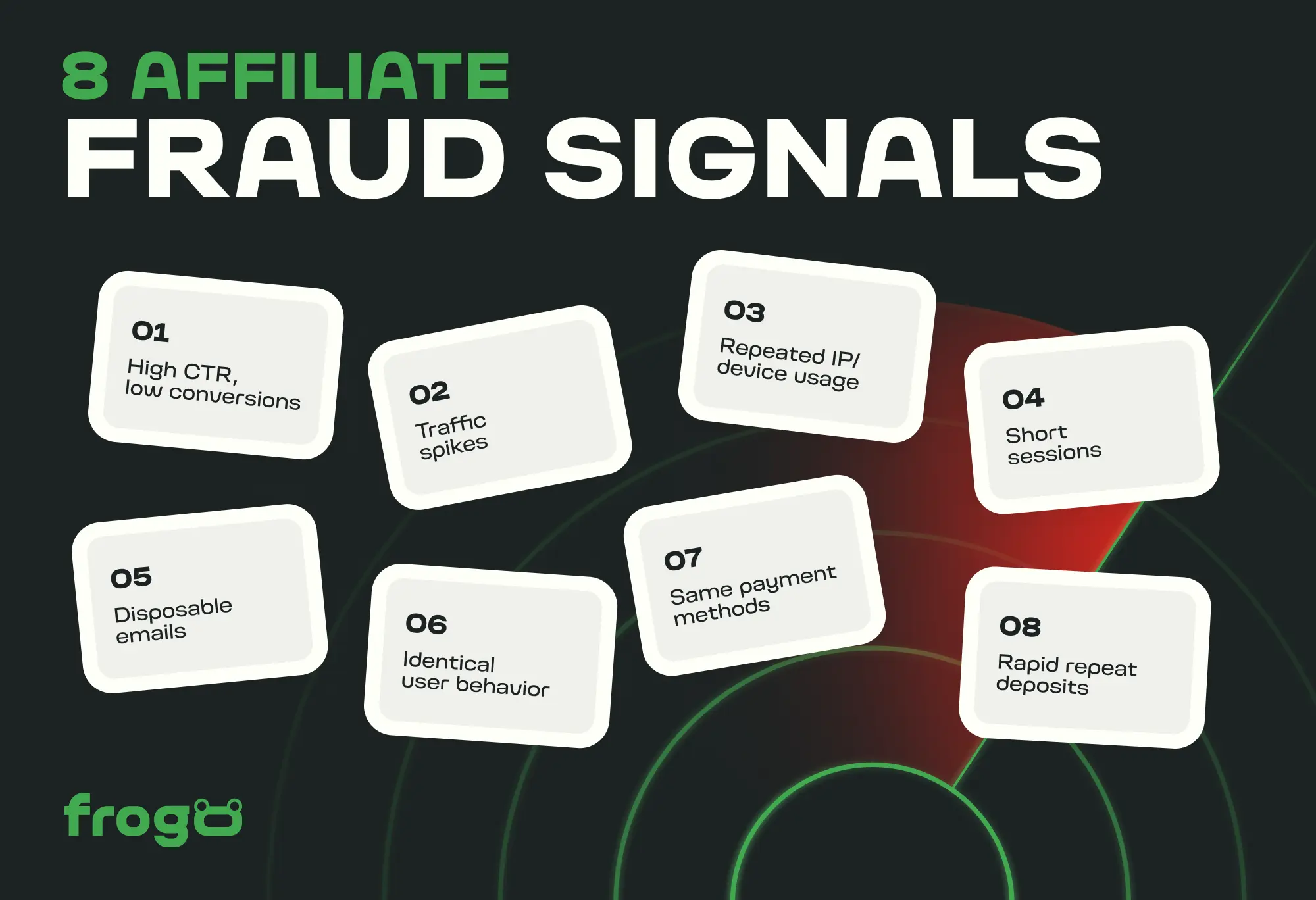
- High CTR paired with low conversion or weak activation after sign-up.
- High bounce rate or near zero engagement depth.
- Sudden spikes in volume with flat revenue or flat downstream actions.
- Traffic from regions that do not match your normal geo mix or the affiliate’s stated placements.
- Unusual device composition, outdated browsers, or a narrow cluster of identical device types.
- Sessions that last only a few seconds, or repeat sessions that follow the same path every time.
- Concentration of clicks or sign-ups from the same IP ranges, ASN, or data center patterns.
- Identical browsing patterns that indicate bot activity.
Step 3: Monitor post-conversion quality
Many fraudulent affiliate streams are designed for short-term payouts, not long-term value. Their problems often appear after registration.
Watch for:
- Poor lead quality. Emails that can only be used once, virtual numbers, and repeated verification attempts using similar credentials.
- Deposit amounts that are the same for many users.
- Losses that happen quickly in high-risk gameplay or unusually fast losses after the first transaction.
- Spikes in chargebacks or refunds that happen quickly.
- Affiliate payouts that are unusually high in a short time period without matching cohort value.
Step 4: Use specialized detection tools
To spot fraud in affiliate marketing, you need a special system that checks traffic quality and user behaviour at every stage. This should include things like device fingerprinting, risk scoring, behavioral analytics paired with a real-time alerting system.
The system should compare each affiliate stream with the usual product activity and highlight anything unusual. Alerts should show what has changed, which affiliate or sub-source is responsible, and which users are affected.
4 Ways to Prevent Affiliate Fraud
While detecting fake traffic is crucial for blocking bad actors, prevention is more effective to avoid losses in marketing spend. To that end, use these four affiliate fraud prevention methods.
Review Terms and Conditions
Your program rules should clearly define what affiliates can and cannot do. They should include examples of prohibited behavior, fraud definitions, and penalties for violations. Clear rules reduce ambiguity. They also give your team a stronger basis for rejecting payouts, suspending partners, or terminating abusive affiliates.
Select the Right Monitoring Tools
Blocking invalid traffic is about more than just maintaining IP blacklists. To stop fraud, you need a tool that checks traffic quality all the time and reacts quickly.
A modern system should automatically compare each affiliate stream with the product’s normal baseline. It should look at things like how many people are clicking on links and signing up, how well the funnel is working, geographical patterns, device fingerprints, IP and ASN reputation, how well customers are retained, and how people behave when they first make a transaction.
If something unusual appears, the system should alert the team straight away. The goal is to pause a stream, block a sub-affiliate, or tighten the rules before the budget is spent.
Frogo tip: Use dynamic monitoring rules to track the same anomaly signals over time. They require far less manual tuning because they learn your product’s normal pattern and trigger only when a stream moves into genuinely abnormal territory.
Vet and Audit Your Affiliates
At the end of the day, whether you’ll have to deal with affiliate fraud depends heavily on who you choose to be your affiliates. So, don’t auto-approve your affiliates. Instead, check their track record, reputation, longevity, and digital footprint before approving them. Then, regularly check in on their performance.
Carry On With Partnership Monitoring
Affiliate relationships shouldn’t be “set and forget.” Even trusted partners can get compromised or start cutting corners under pressure. Regular audits, spot checks, traffic reviews, and ongoing communication maintain both compliance and trust.
Frogo tip: Build a transparent review culture. Share key performance insights with affiliates – both good and bad. When partners know you track metrics closely and fairly, they’re less likely to risk fraudulent behavior and more motivated to deliver sustainable results.
Affiliate Fraud Protection Checklist
Whether you’re building a fraud protection strategy from scratch or revising your current approach, here’s your cheatsheet for affiliate marketing fraud protection:
| Phase | Key steps |
|---|---|
| Laying the groundwork | Add clear fraud definitions to terms and conditions; define penalties; dedicate resources to investigations; screen new affiliates; audit existing partners; select and integrate a fraud prevention solution |
| Monitoring affiliate traffic | Configure IP fraud score checks; use blacklists and whitelists; track session duration, CTR, traffic sources, and engagement; implement behavioral analytics; use device fingerprinting; monitor user activity beyond sign-ups |
| Reducing chargeback risk | Add strong authentication, such as 3D Secure, for card transactions where applicable; track refund and chargeback spikes by affiliate stream |
The checklist works best when treated as an ongoing operating process, not as a one-time setup task.
Final Thoughts: Don’t Let Fraud Undermine Your Marketing
Affiliate fraud has been around for as long as affiliate marketing itself. But that doesn’t mean you should accept it as the cost of doing business. After all, unchecked affiliate fraud can cost you nearly a fifth of your marketing spend.
Don’t know where to start with affiliate fraud prevention? Frogo’s team helps businesses devise and implement comprehensive anti-fraud strategies to combat all fraud risks. Discuss how we can help you maximize the ROI of your fraud protection efforts directly with our experts.