BIN Attacks Explained: Detection & Prevention Guide
BIN attacks usually don’t start with someone spending a lot of money on something. More often, they start with a wave of tiny payments, failed authorisations, or account registrations that look annoying rather than dangerous. That is exactly why they work.
A BIN attack is when criminals target businesses that accept online card payments. They then use stolen card details to steal money from customers. Scammers use technology to test a lot of possible payment details, find active cards, and get ready for more serious credit card fraud later.
To a shop owner, the early activity may look like normal customer mistakes. There were a few wrong card numbers. Several declined transactions. There might be a small increase in payment attempts. On their own, none of these events seems very serious. If you look at the pattern, it might show that the cards are being tested illegally.
It’s important to spot BIN attack patterns early on. Businesses need to look at the bigger picture. They need to connect payment behaviour, devices, accounts, card ranges and authorization attempts. They can’t just evaluate every transaction on its own. Otherwise, a checkout page can be used by criminals to check if a card is valid.
What Is a BIN Attack?
A Bank Identification Number, or BIN, is the set of numbers at the start of a payment card number. It tells you which card network the card is from, which bank issued it, what type of card it is, and sometimes which country it is from or what product category it is.
When you make a payment, the BIN helps the payment gateway, the payment processor and the card issuer to process the transaction. It is a normal and necessary part of processing cards.
Thieves trick people by using a process called BIN enumeration. Instead of getting all the details of a card from one place, they look at the details of a few different cards and try out different ways to see which ones are real.
The point is not to make money from every test. The early goal is validation. Attackers want to learn which cards are active, which details pass basic checks, and which merchants have weak controls.
If the test is successful, stolen card data can be worth more. Once criminals know a card is active, they may use it to make larger purchases, sell it on, or use it in a broader payment fraud campaign.
This difference is important. Even if a small transaction doesn’t work out, the merchant might still provide the attacker with useful information. So, BIN attack prevention needs to look at both approved and rejected payment activity.
How BIN Attacks Work
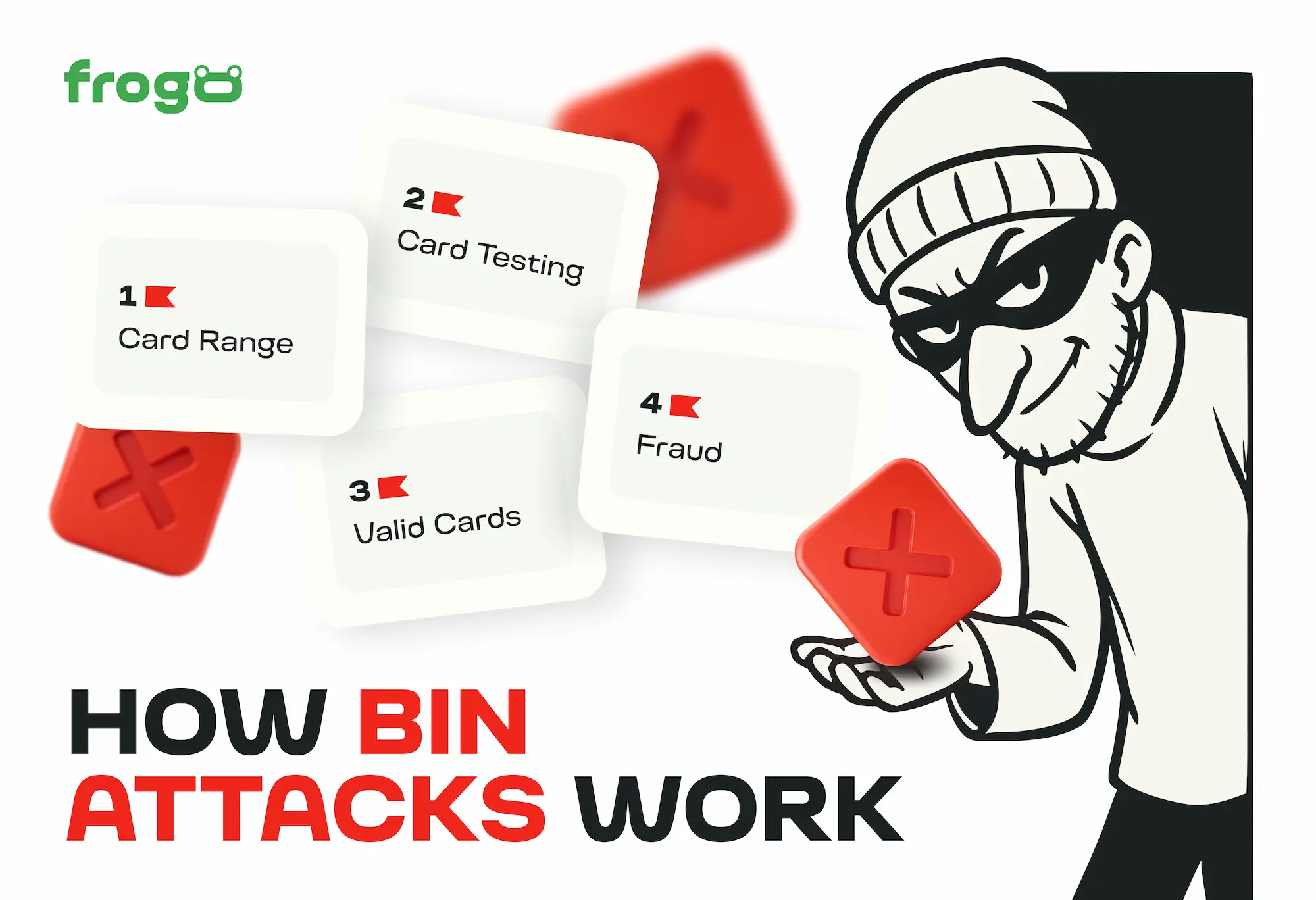
A BIN attack usually follows a pattern. The exact tools and methods used can vary, but the business-side pattern is usually similar.
First, criminals focus on one or more BIN ranges linked to a particular issuer, region, or card product. Then they use automated attacks to submit lots of payment attempts through online checkout forms or payment endpoints.
Some transactions fail because the card number is wrong. Others reach the issuer but fail additional checks. Only a few may be approved. Each result gives the attacker feedback, even when no expensive purchase is made.
The typical pattern looks like this:
- A BIN range becomes the focus of repeated payment activity;
- Automated systems generate large numbers of authorization attempts;
- Payment responses help separate invalid credentials from potentially active cards;
- Validated credentials are used in later fraud or sold to other criminals;
- Larger purchases may follow once the testing phase is complete.
Automation makes the process dangerous because one attacker can generate a volume of transactions that would be impossible to do manually. A script can spread attempts across different accounts, devices, network addresses and merchant pages. Simple limits may catch one part of the activity, but miss the campaign.
This is why it’s important for fraud detection to look at the bigger picture, not just individual approvals. The pattern across failures, devices, time windows, and BIN concentration often tells the real story.
Why BIN Attacks Are Difficult to Detect
It is normal for a card payment to fail once. Customers sometimes enter incorrect card details, use cards that have expired, enter the wrong security code, or forget that their bank blocked an online purchase. This background noise helps BIN attacks to hide.
Attackers often use low-value transactions because they attract less attention and are easier to complete. They can also share attempts across many accounts and devices, making it impossible for any one user profile to show extreme transaction velocity.
There are several reasons why it is harder to detect:
- Individual payments may look like ordinary customer errors;
- Transactions can be spread across multiple accounts and network locations;
- Attack volume may increase gradually rather than appearing as one obvious spike;
- Some attempts use realistic customer details;
- Activity may be fragmented across separate merchants or payment channels;
- Approved payments may be too small to trigger manual review.
The merchant may see a few failed payments from one account, a few more from another, and several tiny approvals elsewhere. On their own, the events are weak fraud signals that something is not right. Viewed together, these events indicate coordinated testing activity.
If there are a lot of transactions, this creates another problem. Big online shopping platforms already handle thousands of legitimate payments, refunds, retries and declines. A fraud campaign can blend into that traffic unless fraud monitoring tools compare patterns across all the data.
So, what makes the attack obvious? It’s usually repetition. Even if a single payment doesn’t look suspicious, there are other ways to spot a campaign. These include the same BIN range, similar transaction amounts, linked devices, unusual account creation and rapid authorisation behaviour.
How BIN Attacks Work in Practice
The following examples show how a BIN attack may be seen from the point of view of a merchant or risk team. These examples focus on defending, not attacking.
Scenario 1: Testing Stolen Card Data
A shop owner sees a sudden increase in attempts to process small payments. Most payments are declined, but a few succeed.
The accounts are newly created. They don’t have much shopping history, they move to checkout quickly, and they try several cards within minutes. The products are inexpensive digital goods.
This pattern may be a sign of card testing fraud using stolen card data. Thieves are not really interested in cheap products. They are checking that payment details work.
The most common warning signs are:
- Unusual rate of decline;
- Many failed payments;
- Multiple cards linked to the same account or device;
- Repeated low-value authorization attempts;
- Unusual behaviour before checkout.
Basic rules may stop an account after several warnings. But if the attacker opens another account straight away, account-level limits alone won’t solve the problem.
Scenario 2: Automated BIN Enumeration
A payment team sees a lot of transactions for cards from the same issuer. The customer names and account details change, but the first digits of the cards repeat a lot more often than usual.
Most transactions fail. Some of them have been approved. The timing is very consistent, with attempts happening at regular intervals.
This is a classic defensive signal of BIN enumeration. It is more important to focus on the overall concentration around one issuer than on any single payment.
Key indicators include repeated BIN ranges, consistent transaction amounts, regular timing patterns, and a sudden increase in declined payments. The business may also notice that the number of payment attempts has changed a lot compared to the number of completed purchases.
A normal sales campaign will increase the number of people browsing, the number of people adding things to their cart, and the number of successful orders. A BIN campaign might lead to more account registrations, but this doesn’t necessarily mean that customers are actually engaging with the site.
Scenario 3: Low-Friction Checkout Abuse
A digital platform offers a fast checkout with minimal registration. This is good for conversion. It can also attract people looking for an easy way to check the details of credit or debit cards.
The platform starts to see more new accounts being created, small purchases being made, and repeated payment failures. Many users leave the site straight after making a purchase. They don’t use the product, they don’t interact with support, and they never return to the platform.
A low-friction design is not necessarily a sign of poor payment security. But to make frictionless payments work, there need to be strong controls in place. Otherwise, it becomes easy for bots to use.
Teams responsible for risk should look at how customers set up accounts, how long it takes to complete the checkout process, whether devices are reused, how often payments fail, and how customers behave after making a purchase. If a customer creates an account and makes a purchase quickly, they may be a real person. But hundreds of accounts following the same exact path are another story.
Scenario 4: Multi-Account Fraud Campaigns
Simple velocity rules often monitor how many transactions one account can make in a set period. But fraudsters know this, so they distribute activity across multiple accounts.
A merchant may see hundreds of accounts, but each account is used only two or three times. The account-level threshold is not exceeded. However, many profiles share devices, browser characteristics, network infrastructure, or behavioural patterns.
This is where device fingerprinting can help. It can help you see relationships that usernames and email addresses hide.
Multi-account campaigns can be identified by:
- Shared devices across supposedly unrelated users;
- Similar account registration sequences;
- Overlapping IP or network patterns;
- Repeated BIN ranges;
- Identical purchase amounts;
- Coordinated bursts of activity.
The campaign looks fragmented, but it’s not. Taken together, these signals reveal a coordinated campaign.
Common Warning Signs of a BIN Attack
Businesses usually identify BIN attacks through pattern recognition. One failed payment proves very little. A cluster of unusual events tells a stronger story.
| Warning sign | Why it may matter |
|---|---|
| Sudden transaction spike | Automation can create far more attempts than normal customer traffic |
| High decline rate | Invalid or incomplete credentials generate repeated issuer declines |
| Repeated authorization failures | Attackers may test many possible card combinations |
| BIN concentration | A large share of attempts may target the same issuer range |
| Multiple cards per device | One operator may test several payment credentials |
| New account surge | Automated registrations can support distributed attacks |
| Repetitive low amounts | Small payments are often used for card validation |
| Unusual timing | Machine-driven attempts may arrive in rapid or regular intervals |
These signals are more useful when they are combined. For example, a sudden increase in transactions may be due to a marketing campaign. If there’s a high decline rate, it could mean that there’s been a payment issue. But there are some signs that it might be a bot activity: lots of transactions, the same BIN range, shared devices, and machine-like timing.
A good BIN attack detection system should check both successful and failed payments. Merchants sometimes closely monitor approved fraud, but treat declines as if they are someone else’s problem. That’s not right. If the value goes down, it might show that the testing phase is coming to an end and that bigger losses are on the way.
Strong controls usually include the following:
- Monitor transaction velocity across accounts, devices, cards, IP ranges, and BINs;
- Apply device fingerprinting to identify linked profiles and repeated infrastructure;
- Use risk scoring that considers payment behavior, account age, device history, and issuer concentration;
- Detect abnormal ratios between account creation, checkout attempts, approvals, and failures;
- Add step-up verification when several risk factors appear together;
- Review unusual issuer-level patterns with the payment processor or gateway provider;
- Adjust controls dynamically instead of relying on one fixed decline threshold.
Rate limits are useful, but they should be applied to several different areas. If there’s a rule that only limits the number of attempts per account, it’s easy to get around by using multiple accounts. A rule that only tracks IP addresses may not work well with distributed networks.
Modern card fraud prevention systems use all of these signals to stop fraud. If one device uses several accounts, each account tries several cards, and most cards share a BIN range, the combined risk is much higher than any individual event suggests.
It is also important to avoid overreacting. Blocking every card from an issuer because of a short spike can reject legitimate customers. Better BIN attack prevention uses layered responses: slow suspicious traffic, request additional verification, limit repeated attempts, route uncertain cases for review, and block only when the pattern is strong.
The payment gateway plays an important role here. Data at the payment gateway level can reveal authorization patterns that are not easily seen from order records. Merchants should also work with their payment processor to understand decline codes, issuer concentration, and changes in authorisation quality.
Final Thoughts
BIN attacks are still a big problem because they take advantage of something every online business needs: the ability to accept card payments quickly.
The first stage of an attack often looks harmless. Small payments, cards that are not valid, new accounts and different payment attempts are not always noticed. But these events can help criminals get ready for bigger credit card fraud.
This is why effective BIN attack detection focuses on patterns across many transactions, rather than on one suspicious payment. Risk teams need to compare BIN ranges, devices, account creation, decline rates, timing, and transaction velocity.
Strong BIN attack prevention uses behavioural analysis, device fingerprinting, velocity controls, issuer-level monitoring, and contextual risk scoring. None of these signals is perfect on its own. They can spot activity that the simple checkout rules don’t catch.