Bonus Abuse Fraud in iGaming: How to Protect Your Bottom Line
Account takeovers, identity fraud, money laundering rings, credit card fraud. These fraud risks might be dominating your anti-fraud preparations. Yet, they’re not the most common type of fraud your iGaming business will encounter. For many operators, bonus abuse is one of the most frequent and costly fraud patterns.
Representing around two-thirds of all iGaming fraud cases in 2024, bonus abuse will inflate your customer acquisition costs and expose you to regulatory risks if it goes unchecked. Here’s how to protect your bottom line with bonus abuse fraud prevention and detection.
To protect your profits, you need more than stricter bonus terms. You need to check how promotions work, where traffic comes from, how users move through the site, and how internal fraud is handled. Then, you need to link these to real-time detection and explainable decision-making.
Here’s how bonus abuse works, how to detect it, and how to stop it.
What Is Bonus Abuse?
In iGaming, bonus abuse fraud happens when users circumvent your policies to benefit from more bonuses than they’re entitled to. For example, they may create multiple accounts to get welcome or no-deposit bonuses more than once. Or, they may do the same thing to fake referrals and get the corresponding bonuses without actually bringing new customers on board.
Be mindful: In many cases, bonus abuse is done by legitimate players who simply want to “game the system”. However, that doesn’t mean that you won’t encounter well-organized fraudster rings or sophisticated bonus abuse methods.
Today, when players abuse bonuses, it is rarely just one person opening a few duplicate accounts. Fraudsters can use a number of different methods to commit fraud. These include temporary emails, emulators, VPNs, stolen or fake identities, recycled phone numbers, and using multiple accounts at the same time. Some systems are completely automatic, while others mix human and bot-based actions to pass verification checks.
The challenge for operators is distinguishing between opportunistic users exploiting promotions and organized fraudsters abusing the system. Repeated promotional abuse should trigger risk scoring, additional verification, and deeper investigation.
Why You Should Care About Bonus Abuse
If you ignore it, casino bonus abuse will inflate the costs of running promo offers, putting a strain on your resources and draining your revenue. (Tier 1 operators already spend 18% of their revenue on bonuses, and the figure rises to 25% for Tier 2 operators.) In multi-accounting schemes, this form of fraud also distorts your acquisition numbers.
Bonus abuse affects multiple operational teams. Marketing may see inflated acquisition metrics driven by fake sign-ups. Risk teams face additional manual reviews. Payments teams deal with suspicious withdrawals and chargebacks. Retention teams may waste resources on users who were never legitimate players.
What’s more, rampant gaming bonus abuse can also draw the ire of regulators in certain jurisdictions. Worst-case scenario, you may face fines or license suspension if you don’t have safeguards for preventing bonus abuse, especially in case it’s used for money laundering. Making the news for regulatory action also risks eroding user trust.
A strong bonus-abuse strategy helps operators show that they check promotions, look into any unusual activity, and make decisions based on rules that are easy to understand.
How Players May Exploit Your Bonuses
Let’s put ourselves into the fraudster’s shoes. What do they do to exploit your bonuses? The answer may vary from user to user, but common tactics include:
- Multi-accounting: Creating several accounts using temporary email providers, deepfakes, or stolen IDs to benefit from bonuses for new players or fake referrals.
- Credit card fraud: Using stolen credit cards to add funds and get deposit bonuses before the victim claims a chargeback.
- Bonus hunting: Scouting the most lucrative bonuses across different operators to minimize risk and maximize profit.
- Chip dumping: Colluding with other players or using multiple accounts to deliberately lose in P2P games (e.g., poker) and transfer chips to a specific account
- Arbitrage (matched) betting: Placing bets on all possible outcomes in a sports event across multiple platforms using a welcome or other bonuses.
- Bonus bagging: Exploiting free bets to turn a profit; typically involves arbitrage betting or cross-betting.
- Chargeback fraud: Requesting a chargeback after using bonuses and withdrawing winnings.
Fraudsters often take advantage of gaps that are easy to spot: unclear bonus terms, when promotions and sales happen at the same time, weak checks on devices, poor validation of referrals, and data that is not connected between the marketing, payments and risk teams. This is why we need to start preventing bonus abuse by reviewing how bonuses are structured and the internal workflows.
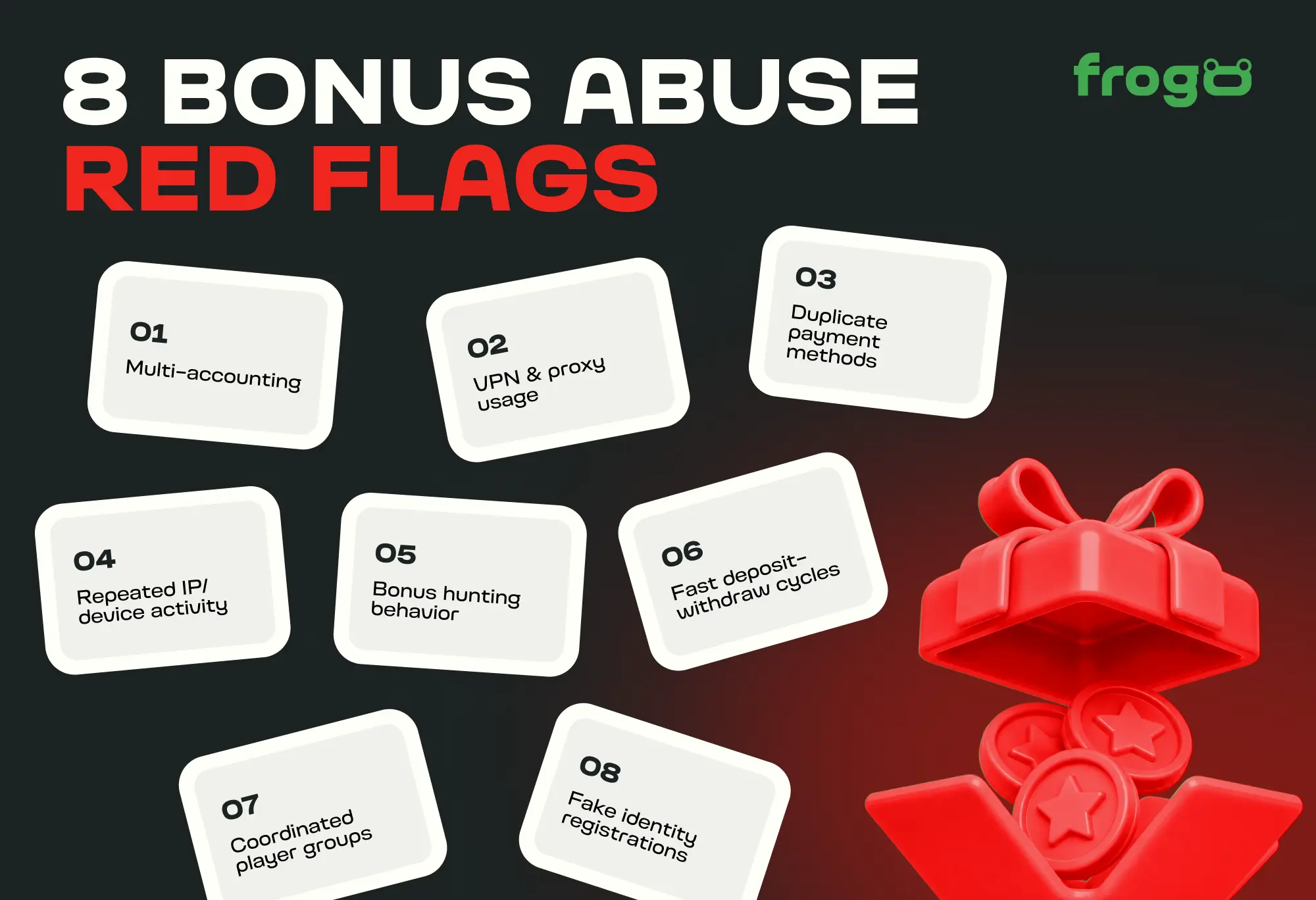
Bonus Abuse Fraud Detection: 6 Red Flags to Know
There are several telltale signs that a user might be exploiting your bonuses, such as:
- VPN, proxy, or anonymous browser use.
- Multiple accounts originating from the same IP address or device ID.
- Device emulator use.
- Multiple accounts displaying similar behaviors.
- Unrealistically fast or large-scale behavior that indicates bot activity.
- Immediate bonus use without regular gaming activity.
Nowadays, people often combine both automated and manual ways of doing things when they are abusing bonuses. Bots can handle lots of registrations at once, while human operators handle actions requiring human input, such as document uploads or selfie verification. This creates patterns that are hard to spot manually.
When dealing with bonus abuse, gambling operators simply can’t detect all of those signs manually, of course. That’s where a bonus abuse solution comes in. It monitors user activity in real time and uses the following technologies to detect bonus abuse underway:
- Device fingerprinting. Assigning a unique ID to every device helps catch instances of multi-accounting. The ID is based on a combination of multiple hardware and software attributes of a specific device (model, browser, screen resolution, etc.).
- Anomaly detection. AI/ML analytics monitors large amounts of data in real time to establish normal user behavior and detect deviations from it. That data can focus on deposit, withdrawal, and login activity, for example.
- Behavioral analytics. A form of anomaly detection, behavioral analytics is fine-tuned to monitor user behavior in particular. It can detect signs of bot activity, for example, or identify when the same behavioral profile appears across multiple accounts.
How to Prevent Bonus Abuse Fraud
Bonus abuse fraud prevention relies heavily on identity verification during registration. Here are the seven measures to help you stop fraudsters in their tracks:
- Leverage IP fraud scoring and device intelligence to catch VPN, proxy, and anonymous browser use.
- Cross-check the data provided by the user (name, address, etc.) against third-party databases.
- Block email addresses containing known temporary email domains.
- Add ID and/or biometric identity verification.
- Implement liveness checks.
- Add CAPTCHA to block bot activity.
- Block VoIP or recycled phone numbers.
The key is to not treat every player the same. Users with low risk should be able to move smoothly through the system. If there is any suspicious behavior, extra checks, manual reviews, or restrictions should be put in place.
Building Long-Term Resilience
It’s important to remember that iGaming fraud detection is something you have to keep working on. Bonus-abuse patterns evolve with new promotions, GEO expansion, traffic sources, payment methods, seasonal events, and acquisition pushes.
That is why operators should regularly check the rules about bonus abuse, the thresholds, and the results of investigations. If a rule causes too many false positives, it should be adjusted. If a new fraud pattern appears, it should become a new trigger. If marketing launches a major promotion, the risk and fraud teams should check how it works before lots of people start using it.
Frogo helps to make things better all the time by using scoring policies, changing thresholds, using AI to reweight things and getting feedback from analysts. The system can show which rules are working, which ones lead to unnecessary manual reviews, and where policy changes may improve detection without harming legitimate players.
Combatting Bonus Abuse Fraud: Your Checklist
Detecting and preventing bonus abuse can be a complex undertaking. Here’s our cheatsheet to help you make sure you leave no stone unturned:
| Phase | Key steps |
|---|---|
| Laying the foundation |
|
| Tackling multi-accounting attempts |
|
| Monitoring account activity |
|
| Minimizing friction for genuine players |
|
Final Thoughts: Don’t Let Bonus Abuse Be
If you run an iGaming platform, you’ll encounter online casino bonus abuse at one point or another. So, prepare for it now; don’t wait until revenue losses become too high to ignore.
There’s good news, however: the measures you take against bonus abuse will also help you combat other forms of fraud. Strong authentication, for example, is effective against account takeovers and multi-accounting attempts.
Need a bonus abuse solution that will also tackle other forms of iGaming fraud? Frogo was built by iGaming experts with 20+ years of industry experience to tackle its unique fraud risks. Contact us to discuss your fraud challenges, and we’ll help you create a comprehensive anti-fraud strategy from scratch.