How to Detect eCommerce Fraud: A Step-by-Step Breakdown
Refund and policy abuse, real-time payment fraud, phishing and whaling, first-party misuse, and card testing. These are the top five eCommerce fraud schemes, and 90% of eCommerce businesses encounter at least one of them. Recent estimates show that fraud losses accounted for up to 3.2% of total annual revenue in 2025.
Catching these and other types of fraud requires a comprehensive approach to eCommerce fraud detection. Here’s your guide for developing one.
6 Types of eCommerce Fraud to Watch Out For
In practice, eCommerce fraud can refer to any fraudulent actions that occur during a typical customer journey, from using stolen credit card credentials to abusing refund policies.
Here are the six most prevalent eCommerce fraud techniques:
- Return fraud: Returning damaged, stolen, or used items, including wardrobing. Customers may return items multiple times, manipulate product conditions, or engage in “wardrobing” (using products temporarily and returning them). Merchants lose both inventory and potential revenue from legitimate sales.
- Payment fraud: Using stolen payment credentials to make a purchase (also known as credit card fraud). Stolen credit cards or compromised payment accounts can result in chargebacks and regulatory reporting obligations. Card-not-present (CNP) transactions are particularly vulnerable in online stores.
- Account takeover: Gaining unauthorized access to a customer’s account and using the stored credentials to make purchases. Fraudsters often acquire stolen credentials through phishing or credential stuffing attacks. This can lead to unauthorized purchases, exploitation of loyalty points, or misuse of saved payment methods.
- Chargeback fraud: Customers falsely claiming they never received the item or that it arrived damaged or not as described (also known as friendly or first-party fraud). Customers may intentionally dispute legitimate transactions to obtain free products or refunds, also called “friendly fraud.” It can inflate operational costs due to investigations and lost revenue.
- Affiliate fraud: Sending spam traffic to your website or making fake purchases to get affiliate perks. Fraudsters create fake accounts or bot traffic to trigger affiliate commissions, inflating marketing costs without generating real customers.
- Discount and promo abuse: Using multiple accounts or exploiting loopholes to get more discounts than customers would be entitled to otherwise. Automated scripts or coordinated groups can exploit multiple promotions simultaneously, eroding margins and undermining marketing strategies.
Frogo tip: Conduct a fraud risk assessment to identify the fraud schemes your business is most vulnerable to. Other types of eCommerce fraud, such as money laundering and card testing, may also come to your attention.
Emerging eCommerce Fraud Trends 2026
eCommerce fraud schemes are evolving rapidly. While traditional tactics like return abuse and payment fraud remain prevalent, new trends are emerging that require proactive detection and prevention.
Key trends to watch in 2026:
- Buy Now, Pay Later (BNPL) fraud: Fraudsters exploit BNPL programs with synthetic identities or stolen payment credentials.
- AI-assisted account takeover: Machine learning and AI help fraudsters automate account credential stuffing and multi-accounting attempts.
- Cross-border fraud: Criminal networks leverage multiple geographies, taking advantage of inconsistent regulatory environments.
- Promo and coupon abuse at scale: Bots exploit discount codes and loyalty points, generating large financial losses.
- Friendly fraud amplification: Customers use chargebacks strategically, combined with multiple account creation to exploit promotions.
Moreover, fraudsters increasingly leverage multi-channel attacks, combining web, mobile apps, and social media to exploit vulnerabilities on different platforms. Detecting such sophisticated fraud requires continuous monitoring of user behavior across these touchpoints. Advanced analytics and machine learning algorithms can correlate patterns across channels, identifying anomalies that might otherwise go unnoticed. For example, repeated login attempts from unusual devices coupled with inconsistent shipping information across multiple accounts can indicate organized fraud rings. By integrating these insights into real-time monitoring systems, merchants can proactively block fraud and adapt dynamically to evolving threats.
Frogo tip: Monitor emerging fraud patterns continuously using AI-powered behavioral analytics. Frogo can flag suspicious behavior across transactions and accounts in real time, helping prevent loss before it occurs.
7 eCommerce Fraud Red Flags to Monitor
eCommerce fraud detection boils down to recognizing the telltale signs of typical fraud schemes. You’ll need an automated software solution to monitor user activity and transactions in real time and flag suspicious actions and orders.
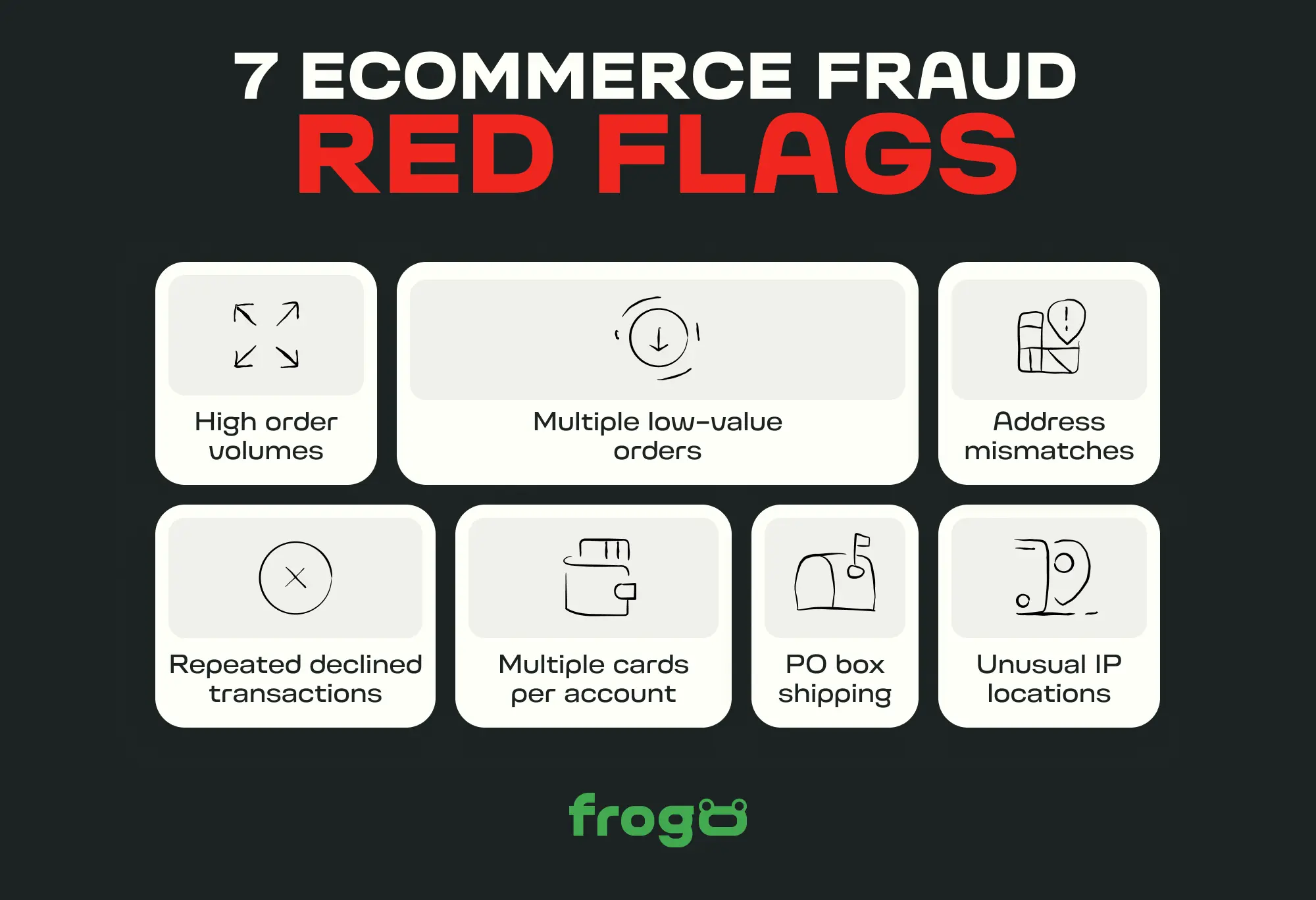
When setting up a solution, pay attention to these seven common fraud indicators:
- Unusually high order volumes or multiple high-ticket purchases: May indicate card testing or coordinated bot attacks; early detection prevents multiple fraudulent charges.
- Multiple low-value orders (common for card testing): Often a method to validate stolen credit cards; detecting patterns helps block fraud before high-value transactions occur.
- Use of different credit cards by the same customer: Could signal multi-accounting or account compromise; flagging these allows additional verification.
- Multiple declined transactions (e.g., due to security code errors): Frequent failures may point to credential testing or payment fraud attempts.
- Unusual IP locations: Orders from unexpected geographies could indicate VPN/proxy usage to bypass fraud rules.
- Billing and shipping addresses that don’t match: High mismatch rates are often correlated with fraud attempts or stolen payment credentials.
- PO box addresses used for shipping: Can signal attempts to obscure physical locations, commonly used in reshipping fraud schemes.
By monitoring these indicators in combination, merchants can establish a more accurate risk profile for every transaction.
Frogo tip: Remember that detecting fraud is only one component of any eCommerce fraud protection strategy. Additionally, implement eCommerce fraud prevention measures, such as email and phone verification, multifactor authentication, and PCI DSS compliance.
Regulatory Compliance & eCommerce Fraud Prevention
Compliance is a critical component of any eCommerce fraud strategy. Adhering to regulatory standards not only mitigates legal risk but also enhances customer trust.
- PCI DSS: Ensure secure handling of payment data across all customer touchpoints.
- GDPR: Protect personal data and maintain proper consent mechanisms for analytics and fraud detection tools.
- AML/KYC: In eCommerce, high-value transactions or new customer onboarding can trigger anti-money laundering checks.
Frogo tip: Frogo’s platform can perform real-time risk scoring before customers finalize orders. By identifying high-risk users early, you can reduce reliance on costly third-party verification checks. A Frogo pre-screen costs only cents, while traditional identity verification can cost several dollars per check.
3 eCommerce Fraud Detection Best Practices
While manual review is a must for suspicious orders, you can’t keep track of all transactions and user actions without an automated tool. The volume and velocity of data are just too great. That’s why eCommerce fraud detection tools are a must.
Here’s how to make the most out of a fraud detection tool:
- Implement real-time monitoring. Integrate the tool with your online store and internal systems to enable it to spot patterns in transactions and user behavior. Real-time systems can analyze thousands of transactions per second, identifying anomalous patterns that may indicate fraud. Combining historical trends with live behavior enhances predictive accuracy.
- Use device fingerprinting. It involves collecting information about the device’s software and hardware configuration to identify it. This technique enables the detection of unusual login patterns, account takeovers, and multi-accounting. Device fingerprints collect over 300+ signals from hardware and software configurations, browser types, plugins, time zones, and IP geolocation. By comparing these against historical patterns, merchants can detect account takeovers and multi-accounting attempts before the checkout is completed.
- Leverage behavioral analytics. Thanks to machine learning, behavioral analytics tracks user behavior on your website or in an app, such as their scrolling, navigation, and typing patterns. If behavior suddenly changes, the tool will prompt risk-based reauthentication. Machine learning models assess how users interact with the site or app, including mouse movements, scroll speed, typing patterns, and navigation flows. Deviations from normal behavior trigger automated verification or reauthentication, preventing fraud before completion.
Once anomalies are detected, automated risk scoring can trigger adaptive responses, such as temporary account suspension, additional authentication steps, or manual review alerts. This approach reduces the window of opportunity for fraudsters while minimizing friction for legitimate users. By combining these automated responses with historical data and behavioral insights, merchants can not only react faster but also continuously refine their fraud detection rules, ensuring a proactive defense against evolving attack patterns.
Case in point: Frogo combines behavioral analytics and device fingerprinting to dynamically assess user behavior. That’s how Frogo detects anomalies in user activity and predicts the likelihood of fraudulent behavior taking place.
Integrating Frogo into Your eCommerce Stack
Seamless integration ensures fraud detection doesn’t disrupt user experience while maximizing protection. Frogo supports flexible deployment across multiple platforms.
Integration points include:
- Website and checkout systems: Embed Frogo scripts or SDKs to monitor device and behavioral signals in real time.
- CRM and marketing platforms: Cross-check customer histories for multi-accounting, promo abuse, or affiliate fraud.
- Payment gateways: Track card BINs, transaction velocity, and unusual patterns before payment finalization.
- Internal dashboards: Provide customer service teams with risk scores, fraud alerts, and recommended actions.
Implementing eCommerce Fraud Detection: 6 Steps to Take
Ready to ramp up your eCommerce fraud detection capabilities? We prepared a checklist to help you make sure you leave no stone unturned:
| Step | Description |
|---|---|
| Implement manual order review: Even with automation, human review is essential for complex scenarios. Train staff to prioritize high-risk orders flagged by automated systems. |
|
| Some businesses choose to integrate external reputation databases. However, Frogo’s scoring relies entirely on proprietary device intelligence and your event stream. |
|
| Build a fraud blacklist: Maintain centralized data on fraudulent users and devices. Automate updates to reduce manual workload and keep detection current. |
|
| Monitor connection methods: IP scoring, VPN detection, and proxy checks are crucial to flag suspicious sessions. Combine with geolocation to detect abnormal patterns. |
|
| Detect payment fraud: Use BIN lookups and transaction velocity checks. Ensure PCI DSS compliance to securely handle card data. |
|
| Assess shipping and ordering behavior: Velocity rules, address verification, and mismatched payment-billing info allow early detection of fraud rings and prevent financial losses. |
|
Training Your Team for Fraud Detection and Prevention
Technology alone cannot prevent eCommerce fraud. Employees and teams must understand how to respond to alerts and anomalies effectively.
Training components:
- Understanding red flags: Teach staff to recognize suspicious transactions, multi-accounting, and rapid promo abuse.
- Incident response workflows: Define clear escalation protocols for potential fraud cases.
- Customer communication: Train teams to handle false positives without hurting the customer experience.
- Regular updates: Keep teams informed on emerging fraud trends and AI-driven detection strategies.
- Incident response simulation: Regularly simulate fraud scenarios to train staff in real-time decision-making. These exercises prepare teams to respond quickly without disrupting customer experience.
- Cross-functional collaboration: Fraud detection requires input from customer support, finance, IT, and marketing. Creating integrated workflows ensures every department understands its role.
- Continuous learning: Fraudsters evolve tactics rapidly. Teams should review recent cases and emerging trends quarterly to refine detection rules and prevention strategies.
Frogo tip: Frogo’s expert team provides consulting and training during onboarding, ensuring your internal team knows how to leverage predictive analytics and risk scores effectively.
Final Thoughts
eCommerce fraud trends evolve quarter after quarter as customers learn to game the system and fraudsters come up with new ways to bypass your defenses. So, regularly revise your fraud detection and incident response measures. Invest in eCommerce fraud prevention alongside detection, too.
Measuring the effectiveness of your eCommerce fraud detection strategy ensures continuous improvement. Key metrics include:
- Fraud attempts blocked: Number of transactions or accounts prevented from completing due to high-risk signals.
- False positives rate: Monitor and minimize legitimate orders flagged incorrectly.
- Chargeback reduction: Track the decrease in lost revenue from friendly fraud.
- Cost savings: Calculate savings from reduced manual reviews and pre-screening with Frogo.
- ROI: Compare the cost of fraud prevention software and internal resources against avoided losses.
Need a comprehensive tool for detecting and preventing eCommerce fraud? Frogo combines static and dynamic rule-based scoring with AI/ML-powered predictive analytics to catch all suspicious activity. Talk to our experts to discuss how Frogo can protect your business against eCommerce fraud.