How to Detect iGaming Fraud: Step-by-Step Guide
It’s official: iGaming fraud is skyrocketing. Since 2022, fraud attempts have increased by a whopping 175%, and the usual deterrents like biometric identification seem to be losing their effectiveness. In fact, 80% of detected iGaming fraud attempts occur during biometric verification — making it one of the most critical stages to secure.
While fraudsters come up with inventive ways to bypass protections that iGaming businesses put in place, the common types of fraud remain consistent. Bonus abuse, chargeback fraud, account takeovers, and affiliate fraud continue causing losses in the iGaming industry.
Here’s how to ramp up your iGaming fraud detection capabilities to stay one step ahead of fraudsters.
Why Detection Quality Defines License, Margins, and Growth
iGaming operates at the intersection of high-velocity payments, bonus-driven acquisition, and strict licensing. The “cost of a miss” isn’t just direct losses or chargebacks—it’s also audits, penalties, higher reserve requirements, and, in extreme cases, license suspension. Regulators in the UK/EU continue to tighten expectations around safer gambling, AML monitoring, bonus transparency, and affiliate oversight.
Practically, if fraud detection isn’t real-time and embedded into business flows, operators pay twice: through immediate fraud leakage and long-term compliance exposure. That’s why modern stacks combine device fingerprinting, behavioral ML, dynamic scoring, and graph forensics, all wired to clear response playbooks.
Frogo covers both dimensions: technology (high-signal data collection, real-time scoring, automated actions) and expertise (policy design per jurisdiction, vertical-specific risk scenarios, continuous tuning). The result is fewer losses and a lower manual workload for your teams, and noticeably better player UX (less friction for good users). Fraud detection stops being a cost center and becomes a growth enabler—cleaner cohorts, steadier LTV, predictable risk, and more confidence to scale promos, geos, and acquisition channels.
What Is iGaming Fraud? 8 Common Schemes
In general, iGaming fraud refers to scams that seek to make illicit gains from either iGaming operators or other players. Fraudsters may exploit loopholes in account security, cheat in games, or use betting to conceal illegal activities, such as money laundering.
Common types of iGaming fraud include:
- Account takeovers: Gaining unauthorized access to a player’s account. After a wave of spear phishing attacks, an operator saw 3 AM login spikes from new ASN ranges. Frogo’s risk-based auth response told the client app to step up with MFA/hold; withdrawals were blocked before funds moved.
- Multi-accounting: Creating multiple accounts to rig game outcomes or exploit bonuses or promos. During a promo, Frogo’s graph view highlighted clusters sharing device and payment attributes. Bonus hunters were ring-fenced and promo budget preserved.
- iGaming affiliate fraud: Generating traffic through fake sign-ups, referrals, bot activity, cookie stuffing, URL hijacking, etc. An affiliate produced “perfect” sign-ups, but device and behavioral signals exposed bots and cookie stuffing. In addition, dynamic rules flagged anomalies in the traffic share from this affiliate compared to product benchmarks—an early indicator of affiliate fraud.
- Bonus abuse: Manipulating bonus offers or promos by using multiple accounts. Instead of blanket restrictions, Frogo scored abuse likelihood and sent signals to the product about potential and confirmed bonus abuse, keeping legitimate players happy.
- iGaming payment fraud: Using stolen credit card data to make transactions (e.g., card-present and card-not-present fraud). BIN probing with micro-deposits appeared as rejection spikes. Dynamic rules throttled the bad flow without harming clean payment methods.
- Chargeback fraud: Disputing transactions after losses to recoup the funds. Repeat disputes (“didn’t recognize charge”) from the same device cluster were identified as a high-risk pattern. Associated identifiers (email, device, card, etc.) were recorded to prevent further deposits from these users; dispute rate dropped.
- Money laundering: Using high-value bets or withdrawals to move illicit funds between accounts or to cash out to unknown payment details. Fast “turnover” patterns — multiple deposits and rapid withdrawals between related entities — surfaced instantly via graph relations and were escalated to compliance.
Affiliate governance matters. Many losses start upstream. Standardize UTMs and use affiliate tracking parameters to monitor traffic sources and score traffic quality (bot rate, duplicate devices, rapid cash-outs) per partner. In Frogo, affiliate signals are incorporated into graph-based analysis and risk scoring, enabling automatic throttling of risky sources and evidence-based payout reviews.
What Is iGaming Fraud Detection?
iGaming fraud detection is the ensemble of tools, policies, and mechanisms your business has in place to catch fraud. It’s not the same as iGaming fraud prevention, however:
- Fraud detection catches fraudsters red-handed to prevent further losses.
- Fraud prevention makes it impossible for fraudsters to scam your business in the first place.
iGaming fraud detection is important not just because it helps reduce fraud losses by identifying and preventing attempts early. Robust fraud detection is also a must for avoiding regulatory fines, license revocations, and reputational damage.
Myth vs. Reality
- Myth: “KYC/AML keeps us safe by itself.”
Reality: KYC is an entry filter. The biggest loss drivers—multi-accounting, bonus abuse, ATO—emerge after onboarding. You need behavioral signals, dynamic thresholds, and graph relations to catch them. - Myth: “Tight static rules are enough.”
Reality: Static rules either punish good users or let adaptive schemes slip. Dynamic scoring (with continuously updated norms) + ML tuned on your data keep precision high as patterns evolve.
The real cost of false positives (FP)
Every unnecessary block/manual review adds friction, suppresses deposit conversion, and inflates support workload. Frogo routes traffic by risk: low-risk users sail through; suspicious flows are stepped-up (captcha/MFA/hold) in your app. Our API returns a real-time decision (allow/step-up/deny) with reasons; your product controls the user experience. That’s how you cut FP without reducing coverage.
In practice, iGaming fraud detection means spotting red flags like:
- Unusual account activity
- Multiple account use
- Invalid or inconsistent personal information
- Unusual login patterns or payment methods
- Multiple high-volume transactions in a brief period of time
- Frequent account recovery requests
- Unusual winning streaks
- Frequent chargeback requests
Frogo tip: To maximize fraud detection effectiveness, combine static business rules with dynamic rules and AI-powered behavioral analytics. The latter will spot anomalies in transactions and user activity to detect complex schemes.
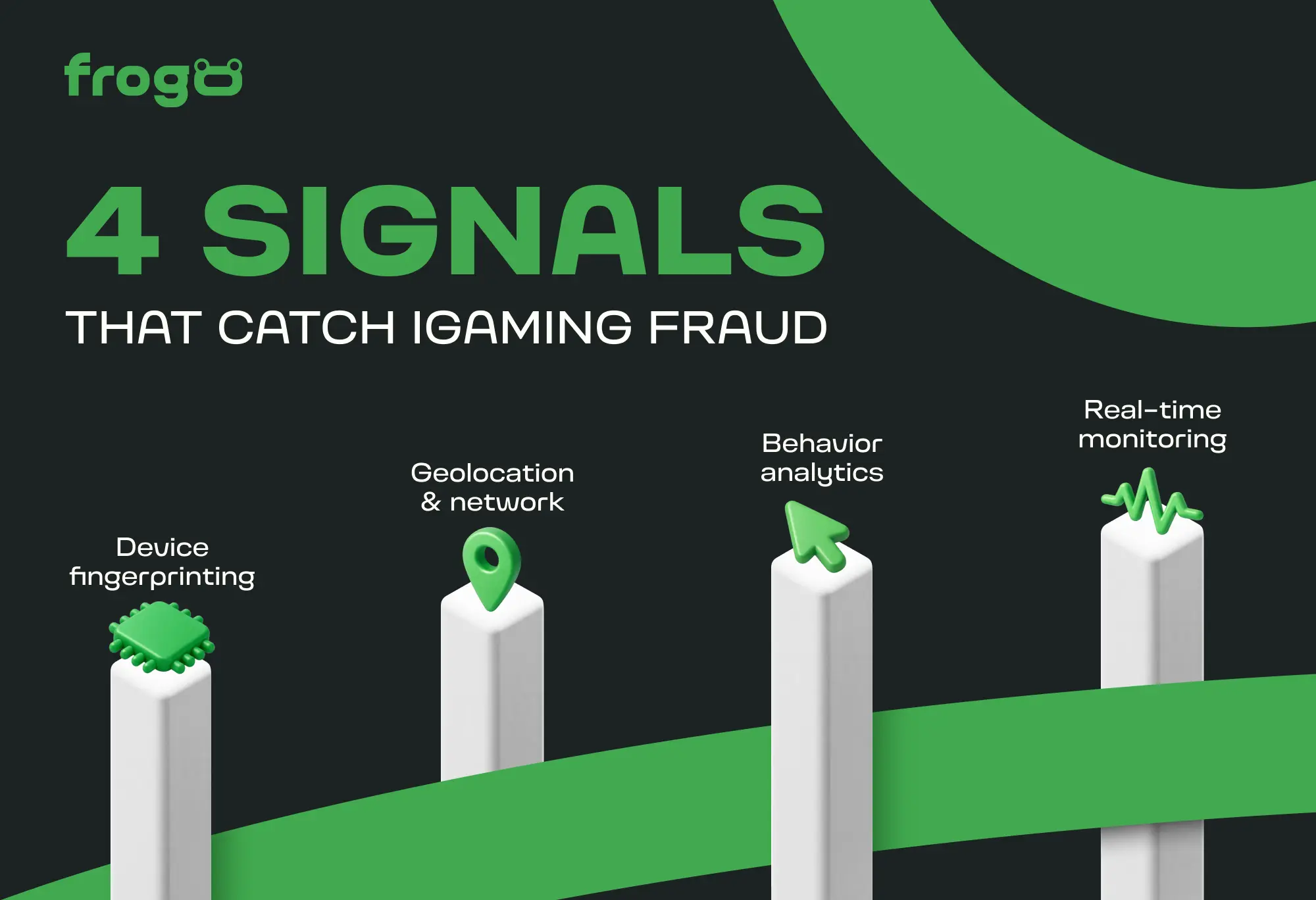
4 Essential Capabilities for Detecting iGaming Fraud
To catch all these red flags in time, you can’t rely on manual checks. No matter how many people you employ, they simply won’t be able to keep up with the volumes of data generated in real time.
So, it’s a no-brainer: you’ll need iGaming fraud detection software. But what should it include? In our experience, these four capabilities are a must for iGaming operators:
- Device fingerprinting: Tracking unique device hardware and software configurations to assign unique identifiers and detect anomalies
- Geolocation verification: Checking the user’s location to detect unusual login patterns, VPN or Tor use, and multi-accounting attempts
- Behavioral analytics: Determining the user’s usual behavior and detecting anomalies that might indicate account takeover or cheating
- Real-time activity monitoring: Analyzing transactions, chargeback requests, user activity, bonus use, etc., to detect red flags based on static and dynamic rules
Case in point: Breaking a Deposit Spam Device-Farm Scheme
An operator struggled for months with deposit spam, leading to payment provider complaints about low conversion quality and elevated fraud rates.
As an initial measure, Frogo analysts implemented targeted rules, reducing fraudulent deposits by 30%. However, fraudsters quickly adapted, changing patterns every few days and forcing constant rule updates.
To create a more sustainable solution, Frogo trained an AI rule-building model on labeled fraud accounts. The model uncovered hidden signals in:
- Deposit amount sequences
- Shared subnet ranges
- 3G/4G mobile connection types
- Hotspot + WiFi device groupings
Fraudsters were operating real-device farms, distributing mobile internet via hotspots. Although IP addresses frequently changed, subnet consistency and network characteristics exposed persistent clusters.
By combining analyst expertise with ML-driven network clustering, Frogo reduced fraudulent deposit spam by 95%+ — without impacting legitimate users.
The same approach is now successfully applied across multiple B2B clients facing similar attacks.
Implementing iGaming Fraud Detection: 5 Key Steps
While fraud detection software is a must, you can’t consider your job done as soon as you add it to your websites and apps. Here are the five steps you need to take to make your fraud detection efforts effective:
| Step | Checklist |
|---|---|
| Conduct a thorough audit |
|
| Implement iGaming fraud detection software |
|
| Set up fraud detection rules |
|
| Configure real-time monitoring |
|
| Define fraud response procedures |
|
Operating model, timeline & KPIs
- Teams & ownership. Process owner: Head of Risk/Fraud. Stakeholders: Payments, Product, Compliance, Data, Support. Frogo provides analyst consultants to tune rules, review incidents, and ship insights every sprint.
- 90-day fast path:
- Days 0–30: Integrate core events (logins, deposits, withdrawals, bonuses), stand up baseline policies, pilot on a traffic slice.
- Days 30–60: Enable behavior & graph, launch risk-based auth, wire dashboards.
- Days 60–90: Optimize thresholds, decrease FP, automate lists & case routing; document playbooks.
- Integration risk to watch: data silos, noisy/duplicated events, inconsistent identifiers, partial payment codes. Remedy: consolidate all sources (payment processors, affiliate tags, CRM, billing, front-end events) and stream to Frogo; we return decisions in real time.
- FP learning loop: your product marks confirmed false positives back to Frogo via API; our team adjusts policy weights/thresholds and retrains models—FP goes down while coverage stays high.
- KPIs to track: fraud-loss rate, chargeback rate, FP rate, % auto-resolved cases (manual-review share), deposit/withdrawal conversion for “green” segments, incident SLA, and ROI (saved $ vs. cost).
Compliance alignment. Log reason codes, policy versions, and linked entities for every automated action, and export monthly audit packs. Map alerts to AML typologies (rapid cash-out, structuring) and safer-gambling markers. This shortens audits, supports SAR preparation, and demonstrates control effectiveness to regulators — without adding manual workload to your fraud or compliance teams
Final Thoughts
Data Readiness & Integration Model
High-precision detection requires complete, timely signals. Best practice is to stream to Frogo: front-end events (registrations, logins, session telemetry, bonus use), payment statuses/codes, CRM attributes, affiliate markers, support tags, and transaction updates. Frogo returns a real-time decision (score + recommended action + rationale). Your app applies the UX (allow / captcha / MFA / hold / deny).
This model delivers:
- More signal – less FP. Models see the whole journey, not just payments.
- Explainability. Dashboards show why a policy fired and how risk changed.
- Control. Update rules without shipping app releases; A/B test policies with Frogo analysts to balance loss reduction and UX.
What’s next: from reaction to anticipation
Top operators are moving to hybrid fraud teams—analysts + ML engineers + rule designers—supported by agentic AI that watches streams 24/7, proposes rule changes with projected FP/UX impact, and shares attack fingerprints across properties. Expect more consortium-level sharing to shrink learning time on new schemes.
Frogo is built for this shift: an all-in-one platform (device fingerprinting, dynamic scoring, AI predictions, graph forensics) plus hands-on expertise (our analysts bring insights, tune policies, and align with compliance). Net effect: lower losses, less manual work, better UX for good players, and more predictable growth.
Done right, fraud detection stops blocking the business and starts enabling it — you launch promos faster, scale into new geos with confidence, and stay one leap ahead of every threat.
There are so many fraud schemes and red flags to track that if you try to catch them all manually, you’ll get lost in the sea of data. That’s why iGaming fraud detection software is a must to spot fraud as it happens — and prevent further losses.
Frogo is an iGaming fraud detection software solution with all the capabilities you may need to spot and respond to iGaming fraud. Get in touch with our experts to discuss how Frogo can help you stop fraudsters in their tracks.