False Positives in Fraud Prevention: Striking the Fine Balance
There’s no such thing as a fraud prevention tool that’s right 100% of the time. Even the most thoroughly tested AI models will, in rare cases, flag genuine transactions as potential fraud.
That doesn’t mean you can just let false positives be, however. There’s a reason they’re also known as “customer insults.” Few genuine customers react with understanding when their transactions are declined. In fact, a quarter of consumers take their business elsewhere after being on the receiving end of a false positive.
Beyond immediate lost sales, false positives trigger a ripple effect across your entire business. Declined legitimate transactions erode trust, reduce lifetime customer value, and distort performance metrics. Marketing and product teams may make poor decisions based on incomplete data – thinking campaigns underperform when in reality, transactions were blocked by your own system.
Frogo tip: False positives are more than “customer insults” – they’re silent profit killers. Each unnecessary decline not only costs the transaction itself but also future revenue from customers who won’t return after a single bad experience.
Keep reading to find out what a false positive in fraud is, why it occurs, and how to minimize your customer insult rate to protect your bottom line and reputation.
What Is a False Positive in Fraud Prevention?
A false positive occurs when a legitimate action gets flagged as a fraud attempt. It can happen when a fraud detection tool declines a payment, blocks a login attempt, or denies a refund request.
While automated tools are often the ones responsible for false positives, they can also occur during manual review.
Frogo tip: Monitor the false positive rate to have a sense of how prevalent false positives are. This rate, also known as the customer insult rate, refers to the percentage of legitimate transactions, users, or other actions among those flagged as fraud. For example, if two out of every 100 suspected fraud cases are actually not fraudulent, the rate is 2%.
While automation gets most of the blame, manual reviewers can also contribute to high false-positive rates. Fatigue, inconsistent criteria, or bias from previous cases can skew judgment. Over time, reviewers may become overly cautious, flagging legitimate activity “just in case.”
To minimize human-driven errors, combine reviewer feedback with automated confidence scoring – letting data guide intuition, not replace it.
Why Do False Positives Happen?
There can be many answers to this question. For example, if the underlying AI/ML model was trained on poor-quality or irrelevant data, it will exhibit a higher false-positive rate.
The way you set rules also matters. A false positive in fraud prevention can be caused by:
- Overly rigid rules may not take into account how customer behavior changes over time. For example, if a customer makes a purchase while traveling abroad, strict location verification rules may decline it based on their geolocation.
- Overly loose rules don’t define fraud signals specifically enough, so fraudsters and legitimate customers get sorted into the same basket. For example, if you treat all incoming traffic from a specific country as a sign of potential fraud, you’ll be alienating real customers residing there or traveling to it.
Finally, during manual review, some behavior may simply come across as suspicious, even if it’s not malicious. Then, your employee might flag it as fraud.
Balancing Risk and Experience
The tension between catching fraud and approving genuine users defines every fraud prevention strategy. Overly strict rules make your system safe but sterile; overly lenient ones leave it vulnerable. The real challenge lies in finding the equilibrium where fraud detection remains effective without punishing legitimate customers.
Frogo tip: Track both fraud losses and false positives on a single dashboard. Many businesses celebrate reduced fraud rates without realizing they achieved them by turning away good users. A balanced KPI view ensures your system protects revenue, not limits it.
The Case for Proactively Addressing False Positives
Whether you like it or not, false positives will happen. However, we always advise our clients to take action to keep them to a minimum. Here’s why:
- Every false positive is a valid customer getting turned away. That doesn’t just aggravate customers – it breaks the trust you worked hard to earn. You’re also likely to see higher churn and lower brand loyalty as a result. For subscription-based products, even a small increase in false declines can have a compound effect, translating into thousands in monthly recurring revenue lost over time.
- High false positive rates will negatively impact your bottom line. If legitimate transactions get declined, that’s lost revenue. Plus, the increased need for manual review will also put a strain on your resources. It’s a double loss – wasted operational effort and missed sales opportunities.
- Dissatisfied customers aren’t good for your reputation. Legitimate customers may leave scathing reviews online or simply encourage their social circle to stay away from your business. And in today’s social-driven world, word-of-mouth spreads fast.
Beyond immediate revenue and reputation loss, false positives also distort your fraud analytics. When legitimate transactions are labeled as fraud, your detection models “learn” the wrong patterns making future predictions less accurate. Over time, the system may overfit to bad data, causing even more declines.
That’s why proactive management requires continuous calibration. Regularly review flagged transactions, measure how many turned out to be genuine, and use that information to fine-tune your risk thresholds. Many leading businesses now treat false-positive rate as a core KPI alongside fraud loss rate. Monitoring both ensures your prevention system protects revenue and user experience simultaneously.
Frogo tip: Track “Review” outcomes vs final analyst decisions. If a trigger fires often but is repeatedly marked legit, lower its weight or convert it to “notify-only” instead of blocking
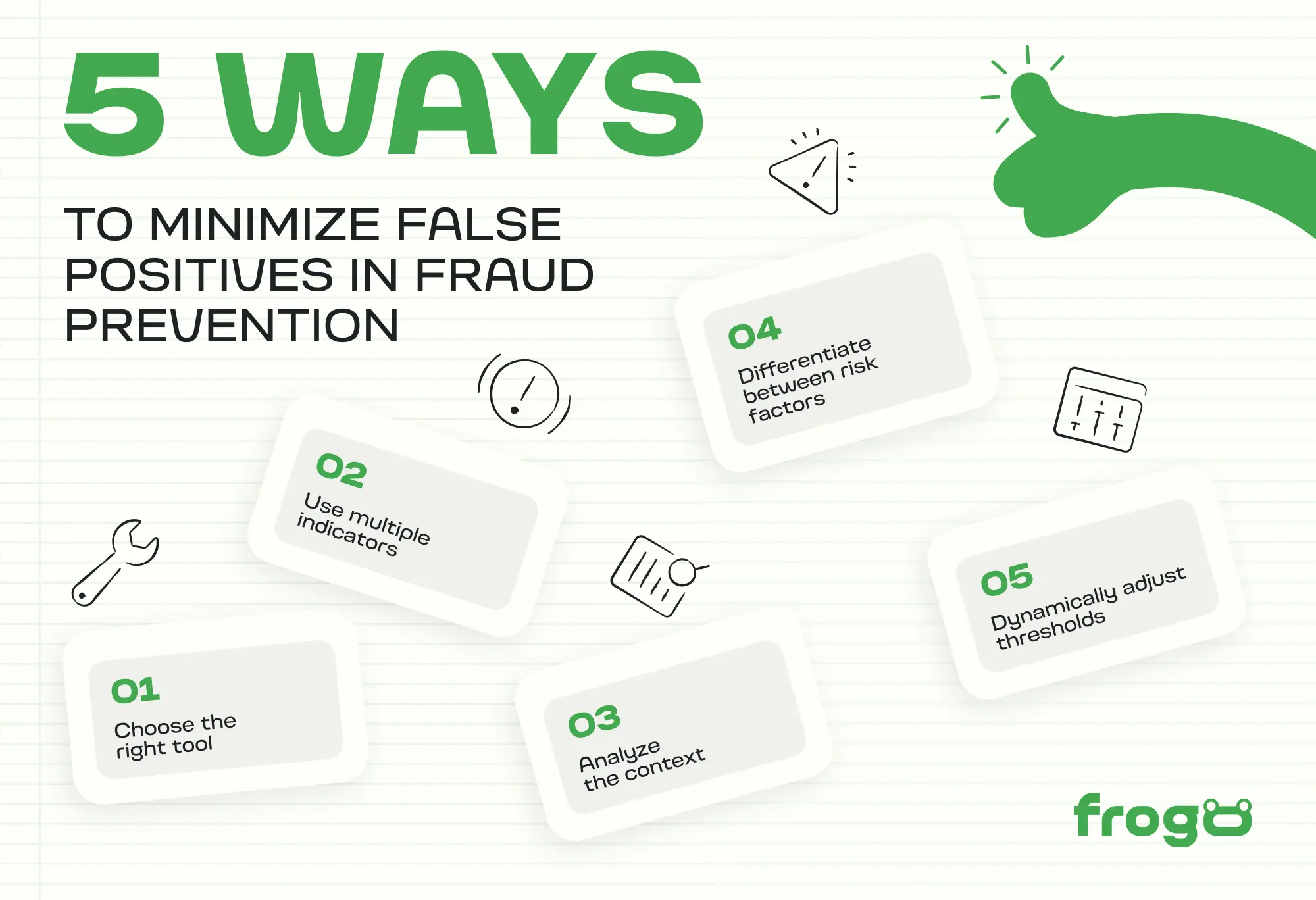
5 Ways to Minimize False Positives in Fraud Prevention
Minimizing false positives is a tough balancing act. On the one hand, you don’t want to frustrate legitimate customers. On the other hand, if you overdo it, some fraudulent activity may slip through.
That said, addressing false positives is still a must. Here’s how to do it.
Choose the Right Tool
While the rest of our methods focus on rules, we couldn’t not mention the importance of choosing an accurate fraud detection and prevention tool. After all, even the most sophisticated rule sets won’t work if the underlying AI or ML model isn’t properly trained, validated, and monitored. A poorly tuned system can create as many problems as it solves – flagging legitimate customers while letting real fraud slip through.
When evaluating tools, look for transparency, scalability, and continuous learning. A modern platform should adapt to emerging fraud patterns in real time, integrate easily with your existing payment infrastructure, and provide clear reasoning behind every decision it makes.
In addition to model accuracy, ensure the tool includes rule segmentation, dynamic thresholds, and other capabilities we describe below.
Use Multiple Indicators
Review your rules. Do any rely on a single indicator to flag fraud? If so, revise those rules to include multiple indicators. Combine signals like location, CVV validity, and address verification for better accuracy.
Fraud detection works best when signals are analyzed together. A mismatched ZIP code alone might be harmless, but with an unverified device or odd login time, it signals real risk. Layering data improves precision and reduces false positives helping your system tell fraud from legitimate behavior.
Analyze the Context
Assessing the risk of an action being fraudulent should never happen in isolation. For example, when your tool analyzes a transaction, it should take into account the user’s history and information. For example, high-value purchases may stand out if the user was only making transactions below $100, but not if the user is a known high roller.
Context turns raw data into understanding. The same behavior can mean risk for one user and routine for another. Combine transaction details with metadata: device type, login time, IP region, or payment history to see the full picture. Machine learning models trained on contextual data can detect subtle deviations that static rules miss, flagging only true anomalies.
Differentiate Between Risk Factors
Not all risks are created equal, and prioritizing them accordingly is key to effective fraud risk management. So, segment risk factors by level of threat. Then, use AI-powered risk scoring to enable different responses, such as adaptive authentication or manual review.
Frogo tip: For medium-risk triggers, start with “alert-only” (Slack/Telegram) or “Review” rather than “Reject,” then tighten once you’ve validated precision in production.
This approach helps your team focus resources where they matter most. Low-risk activities – like returning verified customers – can flow smoothly, while high-risk transactions trigger additional scrutiny. AI systems constantly learn from new data, refining accuracy with every decision. Over time, this builds a self-optimizing defense layer that balances safety with customer convenience.
Dynamically Adjust Thresholds
Dynamic rules, unlike static ones, recalculate thresholds based on real-time user data. This enables the tool to adjust the rules automatically. Ultimately, dynamic rules ensure that what’s considered the “normal” behavior for a specific user is always up-to-date.
Frogo tip: Static thresholds often cause false positives when customer behavior shifts due to traffic source, seasonality, or promotions. Using dynamic, percentile-based thresholds allows fraud systems to flag activity only when it deviates from the current norm for a specific segment, significantly reducing unnecessary declines.
Case in point: Frogo comes with a flexible scoring engine that automates risk assessments based on real-time data. The tool’s dynamic rules make sure it flags activity as suspicious only when it deviates from the most recent norm, thus reducing false positives.
Effective fraud prevention isn’t just about strict rules – it’s about smart systems that adapt. Start with a reliable, well-trained detection tool that supports rule segmentation and dynamic thresholds. Combine multiple indicators, from user activity and location data to device behavior, instead of relying on a single signal. Analyze every transaction in context, comparing current behavior with a user’s history to spot real anomalies. Prioritize risks by severity using AI-driven scoring and apply different responses, such as adaptive authentication for suspicious cases. Finally, let your rules evolve automatically with dynamic thresholds, ensuring “normal” behavior stays current.
When these elements work together, fraud detection becomes both accurate and seamless – protecting revenue without disrupting genuine customers.
Addressing False Positives: Your Checklist
Here’s your cheatsheet for minimizing false positives in fraud prevention:
| Phase | Key steps |
|---|---|
| Selecting and integrating a fraud prevention tool |
|
| Managing fraud risk |
|
| Refining fraud detection rules |
|
| Iteratively improving fraud prevention |
|
Final Thoughts: False Positives Are Avoidable
A risk-based approach and dynamic threshold recalculations, coupled with a reliable fraud detection tool, will help you minimize false positives. That said, without continuous optimization of your rules and settings, your approach won’t deliver the results you expect. So, monitor your false positive rate, regularly test and refine your rules, and listen to customer feedback.
Frogo was built with the risk of false positives in mind. That’s why our tool comes with dynamic threshold settings, a robust risk-scoring module, and a flexible rule system. Talk to our experts to discuss how we can help you implement it and mitigate the risk of “customer insults.”