Fraud Awareness & Prevention: Complete Overview
Fraud is no longer just a security issue. For high-risk digital businesses, it is an operational, financial, and growth problem. For example, according to the 2025 State of Fraud Report 60% of US-based financial organizations reported an increase in fraud attacks on both consumer and business accounts in 2024.
As companies grow, they are more likely to be affected by fraud. New GEOs, traffic sources, payment methods, affiliates, bonus mechanics, subscription models, and customer support workflows all create new ways for people to take advantage of the system.
This is precisely why fraud awareness must become an integral part of day-to-day business management. It is vital for companies to understand where risks arise, which processes are most vulnerable, how to identify suspicious activity, and which tools can help prevent losses before they start to mount up.
Awareness is only the first step. The real challenge for businesses is establishing a systematic fraud prevention process that will enable them to identify threats in a timely manner and minimise financial risks.
What Is Fraud Awareness?
Being aware of fraud means knowing:
- Which fraud risks are important for your business
- Where in your business do these risks show up
- Which teams are likely to spot the early warning signs
- How should suspicious activity be reported
- Where in your business do these fraud risks show up
When it comes to business, fraud awareness and prevention is about more than just educating employees. It is about ensuring fraud awareness is embedded across the organization. The people who decide the prices, the products, the marketing, the affiliates, the support, the retention and the compliance teams should understand how their decisions affect the risk of fraud.
For example:
- Marketing may see a lot of traffic that looks good, but it’s actually getting people to sign up who won’t buy anything.
- Payments can sometimes show deposits that look strange, transactions that don’t go through, or refunds being asked for.
- Support may see that there are a lot of complaints from linked accounts.
- The product may be used in ways that are not intended, which could create opportunities for abuse.
- Teams who investigate risk may not be able to do their job properly because information is spread across different systems.
A fraud-mature organization can connect these signals into a single operational workflow.
Why is it important for companies to be aware of fraud?
Knowing about fraud can help businesses avoid making a common mistake. That mistake is treating fraud as a problem that only belongs to the risk or compliance team.
In reality, fraud signals often emerge outside risk and compliance teams.
In the world of online gaming, it might start with special offers, partner promotions, or how you can withdraw your winnings. In fintech, PSPs, and crypto, it can be seen through how quickly payments are made, fake identities, strange wallets, or when accounts are taken over. In dating and subscription businesses, there may be fake accounts, automated sign-ups, chargebacks, or refund abuse. In banking, fraud often involves account takeovers, payment fraud, social engineering, and account manipulation.
If employees across the organization are unaware of fraud indicators, warning signs become fragmented across teams, making fraud harder to detect. Teams see different symptoms, but nobody sees the full picture.
This leads to:
- Higher losses due to fraud
- Lower campaign performance
- More reviews that are done manually
- More instances of false positives
- Investigations that take longer
- A worse experience for customers
- Risks to its compliance and reputation.
Knowing how to spot fraud helps teams stay alert. Fraud prevention is all about putting that knowledge into practice.
3 Main Components of Fraud Awareness
What does it mean to raise fraud awareness among your employees or customers? In practice, it means guiding them from understanding risks to knowing how to prevent fraud attempts.
Understanding Risks
First, you need to know which fraud schemes your customers are likely to encounter.
For iGaming companies, this may include people having more than one account, abusing bonuses, withdrawing money in a suspicious way, abusing affiliates, and registering bots. For fintech, PSPs, and crypto businesses, it can include account takeover, payment abuse, synthetic identities, card testing, and suspicious transaction patterns. Dating and subscription platforms may have problems with fake accounts, people trying to get their money back, and automated sign-ups. Banks need to make people aware of account protection, payment fraud and social engineering.
Detecting Potential Fraud
Once you know what common fraud schemes are, you can teach your audience to spot attempts at fraud. Define clear fraud indicators and red flags for each scheme.
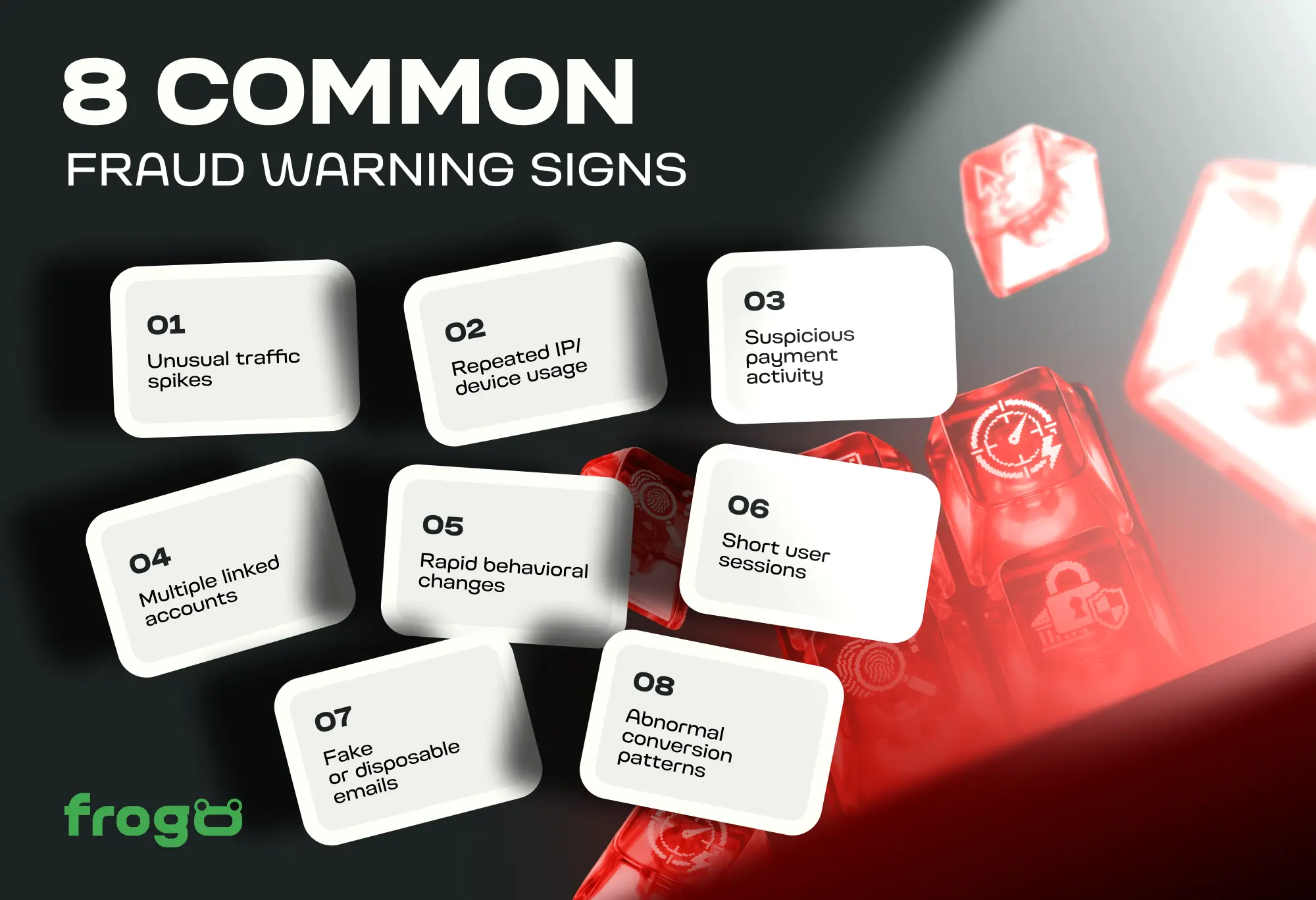
Here are some examples of warning signs to look out for:
- If multiple accounts share similar devices, IP addresses, email patterns, payment details, or behavioral signals
- If a customer has made repeated failed deposits or attempted suspicious payments
- If there is unusual activity on a customer’s account after they have used a bonus
- If there is a lot of affiliate traffic but not many customers sign up
- If there is inappropriate use of promotions or referrals across linked accounts
- If there are customer support requests that do not match normal user behaviour
- If there are employee or admin-panel actions outside of normal thresholds
For teams working with other businesses, it’s important not to rely on guesswork. It’s important to connect red flags to the steps in the process, like who sees the signal, what data they check, where they report it, and how the case moves to risk, compliance, or payments.
Preventing Fraud Attempts
Finally, your employees and customers need to know what they can or have to do to prevent fraud. So, provide information on how to react to a potential fraud attempt. For example, explain how an employee can escalate a potential return fraud case or become a whistleblower for an internal fraud scheme.
Awareness should include reaction playbooks. If support notices link accounts, risk can investigate them. If the marketing team sees traffic from affiliates that looks unusual, the fraud teams should check it out. If payments detect any unusual withdrawals, the case should be reviewed in the usual way. Training people to trigger the right workflow is as important as the workflow itself.
Industry-Specific Fraud Awareness in Practice
Awareness needs context — risks differ across industries.
- iGaming: Fraudsters use multi-accounting and bonus abuse to exploit promotions. Awareness campaigns should teach staff to watch for unusual login clusters.
- E-commerce: Chargeback fraud and fake returns dominate. Train customer service reps to identify repeat offenders and escalate unusual refund requests.
- Financial services: Account takeover and payment fraud are the top risks. Employees should know how to flag suspicious transfers and escalate to fraud teams immediately.
- Dating apps and delivery services: Fake profiles or identity misuse can damage reputation as much as revenue. Educating users about red flags (e.g., requests to move conversation off-platform) is critical.
Frogo supports each vertical with risk-specific policies, dashboards, and awareness content — so training is always relevant to the fraud patterns your staff and customers actually face.
What Is Fraud Prevention?
Fraud prevention is the ensemble of fraud awareness and prevention policies, procedures, and tools your business employs to ensure fraud doesn’t occur.
While fraud awareness is crucial for stopping fraudsters in their tracks, it’s only one part of the overall fraud prevention strategy. So, develop a fraud prevention strategy before focusing on fraud awareness. Since that requires you to conduct a fraud risk assessment first, working on a strategy first will also help you cover all pertinent schemes in your fraud awareness efforts.
In businesses, effective fraud prevention combines people, processes and platforms. People need to be able to spot when something is wrong. The way cases are dealt with is explained in the processes. Platforms help to monitor events, score risk, explain decisions and improve policies over time.
Enhancing Fraud Awareness and Prevention: Your Checklist
Ready to raise fraud awareness? Here’s your step-by-step guide:
| Stage | Key steps |
|---|---|
| Cover the basics |
|
| Educate your employees |
|
| Reach out to your customers |
|
Of course, awareness programs only work if they are owned, repeated, and embedded into daily workflows. Let’s see how to operationalize it.
Operationalizing Fraud Awareness: Ownership, Cadence, and Channels
Awareness only works when it’s run like a program, not a poster. Assign a clear owner (Head of Risk/Fraud or Security Awareness Lead) and define a quarterly cadence with monthly touchpoints.
Ownership & roles.
- Program owner: sets goals, budget, and KPIs.
- Content lead: turns live incidents into short playbooks and micro-lessons.
- Department champions (Support, Payments, Marketing/Affiliates): localize messages and collect feedback from the front line.
- Frogo analysts: feed fresh patterns, tune scoring policies, and supply anonymized cases for training.
Cadence & channels.
- Quarterly deep-dives (60–90 min) by role.
- Monthly micro-nudges in-app/Slack/Email (30–60 sec reads).
- Bi-weekly “Fraud in 5” updates embedded in dashboards.
- Just-in-time prompts inside workflows (e.g., refund screen tips, affiliate-review checklists).
Feedback loop.
Pipe results back into Frogo: confirm false positives via API, tag incidents in the case queue, and compare cohorts (“trained vs non-trained”) in dashboards. This closes the loop between awareness and detection — fewer false blocks, faster decisions, and lower loss per incident.
Customer Awareness in the Age of AI Scams
Now, fraudsters can do more than just send emails that look like they’re from a bank or other trusted company. They can use AI-generated text, synthetic identities, fake documents, deepfakes, and social engineering to make attacks more convincing.
This means that businesses need to educate their customers better. Teaching users to “look for typos” is no longer enough. Instead, campaigns should emphasise:
- Protect your login details and use multi-factor authentication (MFA).
- Check any requests that look suspicious through official channels.
- Avoid clicking on links in emails or messages that you didn’t request.
- Understand why you might need to be verified.
- Report any strange activity on your account quickly.
Businesses should communicate security measures, verification requirements, and fraud alerts clearly to customers. Security messages, verification explanations, and alerts about any suspicious activity should appear at the right time. This could be when you are logging in, paying, withdrawing money, changing your password, or recovering your account.
Measuring Success: Fraud Awareness KPIs
Awareness is only effective if it drives measurable change. Common KPIs include:
- Reduction in phishing click-through rates (tracked via internal tests).
- Increase in fraud incident reports from staff.
- Shorter detection-to-escalation time for fraud cases.
- Higher customer trust scores and lower churn rates after fraud incidents.
The saying “knowledge is power” is especially true when it comes to preventing fraud. If you share this knowledge with your employees and customers, you can greatly reduce the risk of fraud.
The best way to do this is to start by being aware of the problem, then check your internal systems and processes, and finally get industry professionals to help you take action against fraud.
Not sure which fraud risks are the biggest problem for your business? Frogo helps high-risk digital businesses understand how they might be affected by fraud, work out how to audit their systems, and build logic to stop fraud based on real business events. Our expert-driven SaaS platform uses proprietary device fingerprinting, event-level scoring, transparent triggers, graph analytics, alerts, and continuous policy improvement.
Talk to our experts to find out how we can help you create a fraud prevention strategy that works in your day-to-day business — not just in your training materials.