Why Fraud Prevention Management Is Key to Business Security
Fraud isn’t a question of “if” but “when.” An estimated four-fifths of businesses faced fraud attempts in 2024 alone. And fraudsters aren’t pulling their punches: attacks become more sophisticated and incur more damage. In the U.S., almost 60% of businesses reported higher fraud losses in 2025 compared to the year before.
All of that means one thing: you can’t rely on a reactive approach to fraud anymore. You need to take a proactive stance to protect both your bottom line and your reputation. Here’s why – and how to set up a fraud prevention management framework that works.
Most businesses still treat fraud as a series of isolated incidents rather than a continuous risk. But in reality, every transaction, partner, or process carries a potential exposure point. The sooner fraud is embedded into your risk management DNA, the faster your organization becomes resilient.
Frogo tip: Prevention isn’t just technology — it’s awareness. When managers, developers, and finance teams understand how fraud infiltrates systems, they can identify weak spots before criminals do. Make prevention part of every department’s KPIs, not just your security team’s.
What Is Fraud Prevention Management?
Every day, your business may fall victim to multiple fraud schemes, originating both within your organization (internal fraud) and outside of it (external fraud). Fraud prevention management is the ensemble of tools, policies, and processes that you have in place to stop all those fraud risks from being realized in the first place.
Fraud prevention management isn’t a one-size-fits-all system — it adapts to the structure, risk profile, and growth stage of your business. A startup may rely on automated tools and flexible rules, while an enterprise needs layered workflows and specialized teams. The goal is the same: building a framework that scales as fast as the threats evolve.
Effective fraud prevention operates on three levels: people, processes, and technology. People identify anomalies, processes define how to respond, and technology detects threats in real time. Weakness in any layer can compromise the whole framework.
Frogo tip: Risk management and fraud prevention go hand in hand. Yet, fraud detection should also be part of your fraud management approach. Detection capabilities will help you catch fraudsters if they manage to bypass your preventive measures, thereby limiting the damage.
What Is Business Security?
Business security, in turn, is the umbrella term for all efforts to protect your assets from unauthorized access, theft, or damage. Those assets include everything from funds and customer data to your employees and inventory.
Business security isn’t limited to defending assets, it’s about maintaining operational confidence. When systems are protected and processes transparent, teams make faster decisions, customers trust transactions, and leadership focuses on innovation instead of damage control. Strong security transforms from a cost center into a growth enabler.
Robust business security measures ensure the continuity of your operations and prevent financial and reputational losses. The measures themselves can be largely divided into two categories:
- Physical security measures (e.g., CCTV cameras, alarms)
- Cybersecurity measures (e.g., role-based access to systems, data encryption)
Business security isn’t only about locking systems down – it’s about enabling safe growth. When prevention and productivity work together, teams can innovate confidently without fear of data loss or fraud exposure.
Frogo tip: Security metrics belong next to performance metrics. When fraud prevention directly connects to KPIs like retention or revenue stability, everyone becomes invested in keeping the business secure.
Why Fraud Prevention Matters for Security
Prevention of cybercrime and fraud management are often two sides of the same coin. Many fraud schemes rely on gaps in cybersecurity for success. For example, you can prevent one form of affiliate fraud, cookie stuffing, by using secure cookies to track leads and sales.
Cybercrime and fraud prevention overlap more than most teams realize. Credential theft, phishing, and malware are often just the first phase of larger fraud operations. Once access is gained, stolen data feeds identity theft, account takeover, or payment fraud attempts.
On top of that, introducing certain measures often benefits both cybersecurity and fraud prevention. For example, implementing multifactor authentication can protect both your corporate accounts from takeover and your business from data breaches.
Ultimately, businesses that have a holistic approach to cybersecurity and fraud prevention benefit from:
- Minimized financial losses from both cyberattacks and fraud
- Mitigated risk of regulatory fines and legal action due to non-compliance
- Improved customer trust and loyalty
- Mitigated risk of reputational damage from high-profile incidents
Cybersecurity and fraud prevention teams often work in silos – but attackers don’t. The same stolen credentials can fuel both a system breach and financial fraud. Aligning IT, risk, and finance departments under one strategy ensures no signal is ignored.
Frogo tip: Build a shared incident dashboard accessible across departments. When cybersecurity alerts correlate with payment anomalies, response times shrink dramatically, and early detection becomes the norm, not the exception.
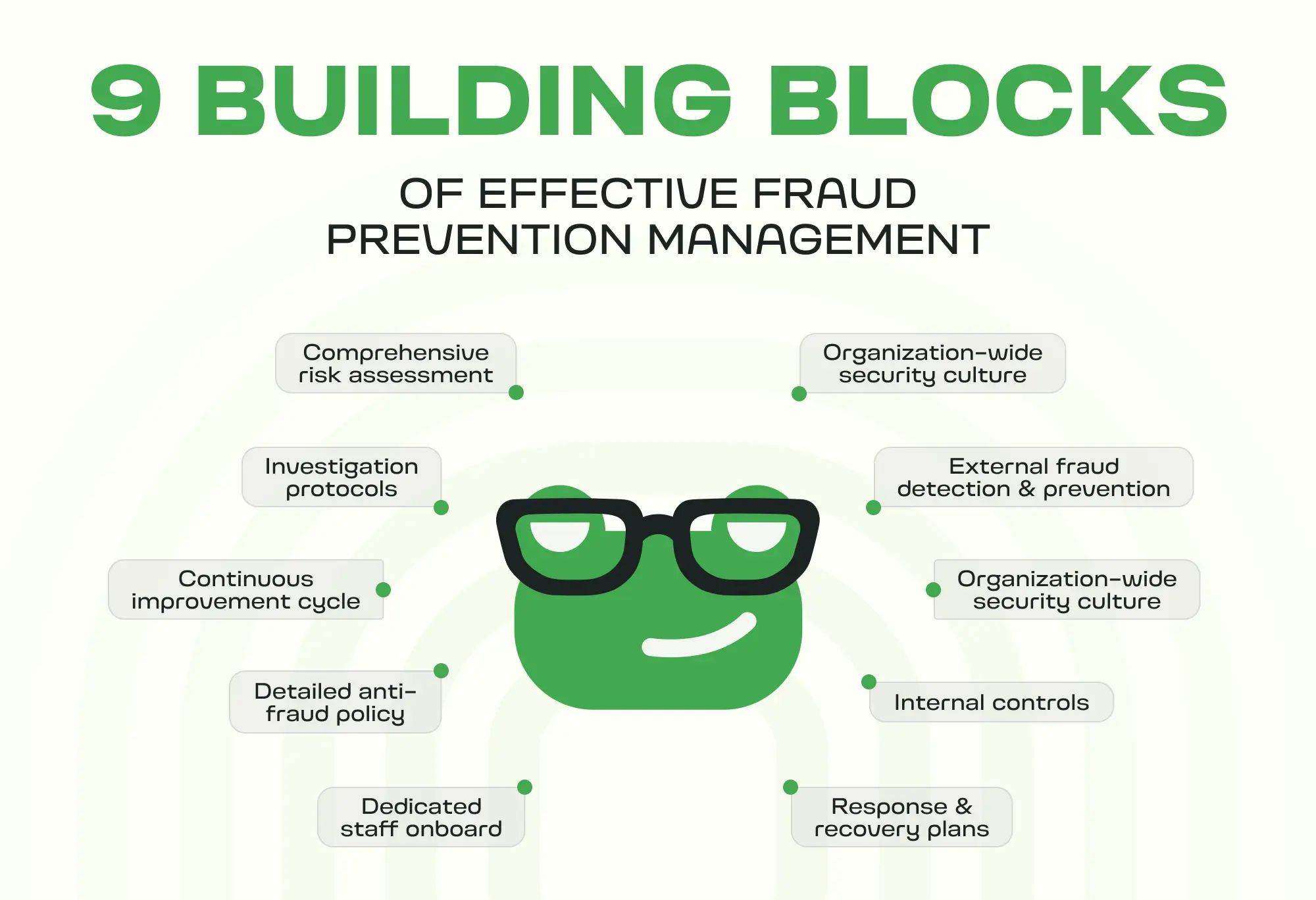
9 Building Blocks of Effective Fraud Prevention Management
Ready to ramp up your fraud prevention and management efforts? Make sure they include these eight crucial components — and don’t forget to choose a trusted vendor that provides a reliable fraud prevention tool, like Frogo.
Comprehensive Risk Assessment
Any anti-fraud strategy starts with identifying all the fraud risks your organization faces. During this review, examine the types of fraud prevalent in your industry and location, as well as any past incidents. Take a look at internal processes and policies to pinpoint potential exploits, as well.
Frogo tip: Enhance your fraud risk assessment with a security audit of your software systems. It’ll reveal the gaps in cybersecurity that could potentially be used to commit fraud.
Detailed Anti-Fraud Policy
This formal document outlines your commitment to catching, preventing, and combating fraud. It typically describes:
- What constitutes fraud
- How to report it
- Who is responsible for fraud prevention
- How you’ll investigate suspected fraud cases
- What consequences fraudsters will face if caught
Dedicated Staff Onboard
Who will oversee, guide, and optimize your fraud prevention efforts? Hire a fraud prevention manager to take on full process ownership if you don’t have one on board yet. Then, consider other roles that may tackle suspected fraud cases. For example, you’ll probably need fraud investigators to conduct manual reviews and unravel schemes.
Hiring specialists isn’t enough – they must be empowered to act. Fraud prevention teams need direct access to transaction data, system logs, and decision-making authority to block high-risk activity instantly. Without it, detection delays turn minor fraud into major losses.
Frogo tip: Cross-train fraud prevention staff with developers and data analysts. When teams understand both human and technical fraud patterns, they catch anomalies faster and design stronger countermeasures.
Organization-Wide Culture
Your whole organization should come together to combat fraud. For example, with a strong anti-fraud culture, your employees will be more likely to recognize and report internal fraud. Build fraud awareness through training and knowledge sharing, and establish a whistleblower process to facilitate fraud reporting.
Internal Controls
Internal controls will protect your business from internal fraud, i.e., fraud committed by your employees on their own or in collusion with third parties. For example, controls for internal fraud prevention in cash management typically include:
- Segregation of duties
- Job rotation
- Screening during recruitment
- Strong authorization workflows
- Immediate recording of cash receipts
External Fraud Detection & Prevention
External fraud can involve anything from users trying to purchase your product with stolen credit card information to fraudsters taking over legitimate accounts. Real-time monitoring and detection will help you catch it in time.
Even the best automation can’t prevent every attack. External fraud often involves social engineering – manipulating real users into sharing access or approving fake transactions.
Frogo tip: Teach customers and partners to spot fraud attempts just as you teach employees. Simple awareness programs – in-app tips, email alerts, or warnings during login – reduce phishing success rates dramatically.
Investigation Protocols
Imagine your fraud detection tool alerts a team member about a suspicious action. What should happen next? Investigation protocols outline these next steps, along with the roles and responsibilities of those involved in the investigation.
Case in point: Frogo speeds up fraud investigations with graph-based forensic tools. Graph technology reveals previously hidden connections between accounts, employees, and third parties to detect complex collusion schemes.
Response & Recovery Plans
Now, imagine that your investigation confirmed that fraud took place. Response and recovery plans will ensure no one panics, and your employees will do everything possible to limit the damage and recover lost assets. That can involve blocking fraudsters’ accounts or taking legal action against them, for example.
Continuous Improvement Cycle
Once a fraud case is closed, don’t move on too quickly. Each incident is a learning opportunity that reveals weak controls or blind spots. Regular post-incident reviews transform short-term recovery into long-term resilience.
Frogo tip: Treat fraud like a recurring audit topic. Update your prevention playbook after every confirmed case. The best programs evolve through iteration – they don’t wait for the next attack to improve.
Pulling It All Together
Each of these nine elements builds a different layer of defense, but they’re strongest when connected into one system. Risk assessment shows where fraud could happen, while a clear anti-fraud policy defines how to react. Dedicated staff give these plans life, supported by an organization-wide culture that keeps awareness high. Internal controls guard against insider threats, and external detection tools shield customer interactions. Investigation protocols ensure no signal goes unchecked, while response and recovery plans turn crisis into order. Finally, a continuous improvement cycle keeps every safeguard relevant as fraud tactics evolve.
Frogo tip: Fraud prevention management works best as a living ecosystem – adaptive, transparent, and shared across all departments. When each block supports the others, you move from reactive protection to proactive resilience.
Ramping Up Fraud Prevention: Your Checklist
We’ve prepared a thorough checklist to help you cover all bases in your fraud prevention efforts:
| Phase | Key steps |
|---|---|
| Laying the foundation |
|
| Preventing internal fraud |
|
| Combatting external fraud |
|
| Building an anti-fraud culture |
|
Final Thoughts: Fraud Prevention Is a Process
Fraud prevention is a continuous effort, not a one-and-done task. Therefore, ensure you have the right people, processes, and technology in place, and regularly refine your policies and protocols. Keep track of fraud prevention metrics to see what works and what could be improved.
Fraud prevention management isn’t just about stopping losses – it’s about enabling confident growth. Companies that treat fraud prevention as part of strategic planning attract more investors, win user trust, and achieve regulatory readiness faster.
Don’t know where to start with building a fraud prevention and risk management strategy? Our team helps businesses in iGaming, fintech, eCommerce, and other domains get it right from the very start. Contact us to discuss your fraud challenges directly with our experts.