Friendly Fraud Explained: Why Chargebacks Aren’t Always Criminal
The word “friendly” makes listeners think of small misunderstandings. But in reality, it refers to customers abusing payment protections in ways that are anything but friendly, like turning ordinary purchases into costly payment disputes.
Unlike many other types of payment fraud, friendly fraud often starts with a real purchase. A customer uses their own payment card or account to pay for something, and later says to the bank that they didn’t pay for it. They may claim the payment was not allowed, the item never arrived, or the product was not what they expected, even when the shop had done what they asked.
Sometimes, the problem is just a simple fault. The buyer didn’t think about something that happens often, forgot the name of the shop, or found an order that another family member made. In other cases, the customer knows exactly what happened and uses the chargeback process to get their money back, even though the purchase was legitimate and the merchant delivered the product or service as promised.
This is why dealing with chargeback scams is always a hassle. The person using the card might be telling the truth. But the dispute claim could be false. What’s more, businesses need to understand that there are mistakes, chargeback abuse, and complaints before deciding how to respond.
What Is Friendly Fraud?
Friendly fraud happens when a customer disputes a legitimate transaction that they, or someone with access to their account, actually made. This is sometimes referred to as first-party fraud. It is a form of fraud in which the person disputing the transaction is one of the parties to the transaction instead of an unrelated criminal.
The card in question may not even have been stolen. In friendly fraud cases, the transaction can look legitimate because the real cardholder made the purchase and later disputed it. Note that most of the time it is entirely acceptable to be a person who possesses more than one bank account. Consequently, all the typical red flags of fraud used by retailers and online businesses to red flag suspicious transactions, are no longer applicable.
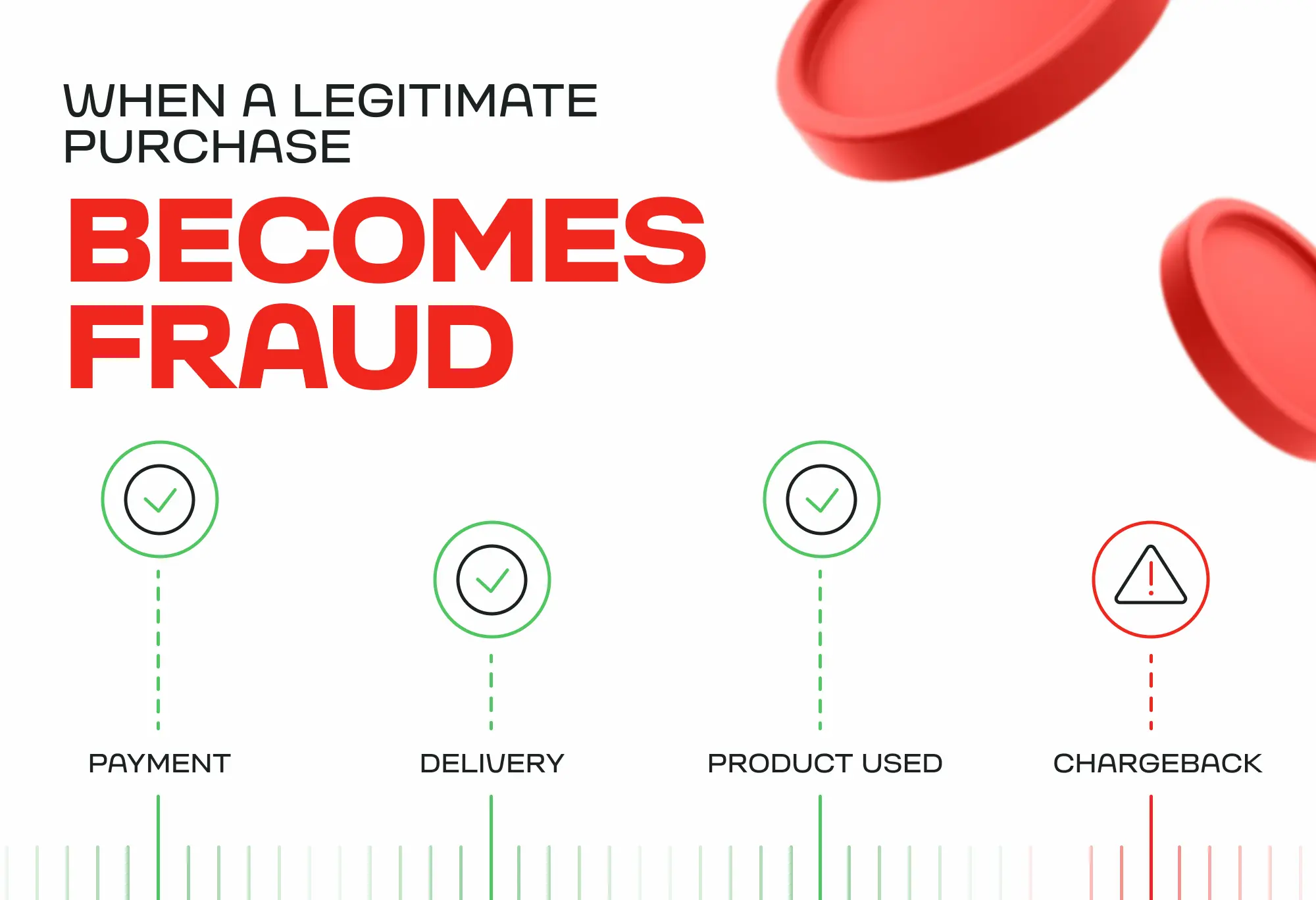
A customer may place an order from a familiar device, use the correct billing details, complete purchase verification, and receive the product at their usual address. Weeks later, they claim the transaction was unauthorized or that the product never arrived.
For the merchant, the checkout looked clean. For the issuing bank, the customer’s dispute may sound reasonable. Somewhere between those two views sits dispute fraud.
How Friendly Fraud Differs From Traditional Fraud
Traditional third-party fraud usually involves a criminal using stolen payment information. Friendly fraud begins with a real customer or an authorized user. That one difference changes almost everything about detection.
| Factor | Friendly fraud | Traditional third-party fraud |
|---|---|---|
| Who initiates the payment | Legitimate cardholder or authorized user | Unrelated fraudster |
| Account ownership | Usually valid | Stolen or compromised |
| Payment authorization | Often completed correctly | Based on stolen credentials |
| Common indicators | Dispute patterns, refund behavior, repeated claims | Device mismatch, unusual location, failed verification |
| Dispute timing | Often after delivery or product use | May appear shortly after account compromise |
| Main challenge | Proving the customer authorized or benefited from the purchase | Identifying unauthorized use before approval |
Conventional fraud systems are built to catch obvious mismatches. They analyze suspicious IP addresses, new devices, unusual purchase amounts, failed authentication attempts, or strange shipping locations.
Those tools are useful against stolen-card attacks. They are less effective against first-party fraud because the customer may pass every normal check.
The payment comes from the correct account. The name matches. The device has been used before. The shipping address is familiar. There may be no obvious risk signals at all.
That is why friendly fraud detection depends heavily on transaction history, delivery evidence, login records, communication logs, previous refund requests, and patterns in customer behavior. It is less about catching a stranger and more about understanding whether a trusted user is abusing the dispute process.
Intentional vs Accidental Chargebacks
Most cases of friendly fraud can be put into two groups: accidental chargebacks and intentional chargebacks. Both result in merchant losses, but the reasons for this are very different.
Accidental Chargebacks
Accidental chargebacks happen when customers honestly believe a legitimate transaction is suspicious or incorrect.
A forgotten subscription is a classic example. A customer signs up for a free trial, continues using the service, and forgets that subscription billing will begin automatically. When the charge appears, they contact the bank instead of checking the account.
Confusing billing descriptors create similar problems. The customer recognizes the store but not the legal company name shown on the statement. To them, it looks like an unknown charge.
Family purchases are another common source. A child buys an in-game item, a spouse uses a shared card, or an employee makes a business purchase. The account owner sees the charge later and assumes the card was misused.
Delayed delivery can also trigger honest customer disputes. If tracking information is unclear and support is difficult to reach, the customer may believe the order is lost.
Intentional Chargebacks
Intentional chargebacks happen when customers knowingly dispute valid purchases to recover their money while keeping the product or benefit.
Some buyers use the chargeback process to avoid a merchant’s refund policy. Others consume a digital product, finish an online course, use a subscription for several months, or spend in-game credits before claiming the purchase was unauthorized.
Bonus abuse is another version. A customer receives a promotional reward, withdraws or uses the benefit, and then disputes the original deposit. The merchant loses both the payment and the bonus.
This behavior may appear as fraudulent chargebacks, refund abuse, or deliberate chargeback fraud. Whatever label is used, the logic is simple: the customer wants the value without the cost.
The Most Common Friendly Fraud Scenarios
Friendly fraud doesn’t always seem obvious. It usually hides inside the normal customer journey.
Forgotten Subscription Renewals
Recurring payments generate a large share of payment disputes because people forget what they signed up for. The first payment may be clear, but the renewal appears months later when the product is no longer fresh in the customer’s mind.
Poor cancellation flows make the problem worse. If users cannot easily find subscription settings or reach support, they may go directly to the bank.
Clear renewal reminders, recognizable descriptors, and simple cancellation options are important parts of friendly fraud prevention. A reminder email may look like a small detail. It can save a full chargeback later.
Family or Shared Account Purchases
Shared devices and payment methods create awkward situations. A child buys game credits. A partner orders something using a stored card. An employee makes a purchase through a company account.
The cardholder may not recognize the charge, even though someone they authorized completed it.
These friendly fraud examples show why authorization is not always clear from the cardholder’s perspective. Merchants should record device details, user profiles, order confirmations, delivery information, and login activity. Those records can support the merchant during dispute management.
Digital Goods and Services
Digital products are frequent targets for chargeback abuse because delivery is instant and physical proof does not exist.
A user can download software, access premium content, spend virtual currency, or consume a streaming service before filing a dispute. The merchant cannot take the product back. It is already used.
Gaming, SaaS, education, streaming, and other online platforms need strong access logs and usage records. Evidence that a customer logged in, downloaded a file, completed lessons, or spent purchased credits can help challenge false claims.
Refund Abuse
Some customers skip the merchant’s support process and contact their bank first. Perhaps the refund policy is strict. Perhaps support is slow. Or perhaps the buyer knows that a chargeback may be easier.
This behavior becomes refund abuse when customers deliberately use the dispute system to obtain money they would not receive through the normal refund process.
The line can be messy. A customer may have a valid complaint but choose the wrong resolution channel. That is why accessible support and transparent policies are so important for chargeback fraud prevention.
The Business Impact of Friendly Fraud
When a chargeback is approved, the merchant may lose the payment, the product, shipping costs, processing fees, and the time spent preparing evidence. Digital businesses lose access value or virtual goods that cannot be recovered.
Repeated chargebacks can also affect the merchant’s relationship with payment processors. High dispute rates may lead to additional monitoring, higher reserve requirements, increased fees, or restrictions on the account.
| Cost area | How friendly fraud affects it |
|---|---|
| Revenue | The original transaction amount may be reversed |
| Product cost | Physical goods may already be delivered and digital goods consumed |
| Fees | Merchants may pay dispute and processing charges |
| Operations | Teams spend time reviewing records and preparing evidence |
| Payment access | Excessive disputes may create processor problems |
| Customer service | Legitimate complaints become harder to separate from abuse |
There is also a data problem. If businesses think every dispute is a case of external fraud, they might block good customers and focus on the wrong controls. If they treat every dispute as a service issue, repeat abusers get away with it.
That’s why it’s not always easy to compare friendly fraud vs chargeback fraud. Friendly fraud can include honest mistakes, while deliberate chargeback fraud is more abusive.
Key Warning Signs of Potential Friendly Fraud
One behaviour does not prove that abuse has taken place. Patterns matter more. Here are some common warning signs to look out for:
- If the same customer, device, address, or payment account keeps disputing something;
- If someone keeps asking for refunds after making a purchase;
- If a customer keeps using a service after saying the payment was not made by them;
- If there are a lot of disputes made soon after a promotional reward is used;
- If there are several accounts connected to the same device or house;
- If someone makes a lot of high-value purchases that don’t match what they usually buy;
- If someone says they didn’t receive something even though there is proof they were sent.
These signs should feed into transaction monitoring, not automatic accusations. A loyal customer may have one legitimate dispute. A serial abuser may keep each account below obvious thresholds.
How Businesses Can Reduce Friendly Fraud
It’s not possible to stop all disagreements. The aim is to stop confusion that could have been avoided, identify cases of repeated abuse, and create strong evidence for cases that still reach the bank. To answer the question of how to prevent friendly fraud, you need to think about the whole customer journey.
- Make sure your bills are easy to understand. The name on the bank statement should be easy for the customer to recognise and should remind them of the brand;
- Send detailed confirmation of purchases. Include the product name, amount, merchant name, date, delivery details and support contact information;
- Let customers know before their subscription is due to renew. Sending renewal reminders helps customers remember upcoming payments and builds trust;
- Make your refund policies easy to understand. Customers are frustrated by hidden conditions and confusing deadlines, which makes them go to their banks;
- Make sure you can always get help from customer support. If you answer quickly, you can stop a customer from filing a chargeback;
- Collect proof of purchase and delivery. Keep records of customer login activity, the device data, order records, tracking, download history, and proof of service use;
- Monitor customer behavior over time. Strong friendly fraud detection looks for recurring disputes, repeated claims, unusual refund patterns, and continued account use;
- Put in place controls based on the risks. If something is considered a high-risk purchase, it may need to be checked more thoroughly. But trusted customers shouldn’t have to go through more steps than necessary.
To facilitate chargeback abuse prevention, the fraud, support, billing and dispute teams need to work together. Support agents may see complaints before the fraud system sees a pattern. The team dealing with disputes may notice that a lot of the claims use almost the same words.
Modern fraud prevention software can help connect these signals, but it’s important not to replace human judgment with automation. There are many unclear areas when it comes to friendly fraud.
Final Thoughts
Friendly fraud is one of the hardest forms of payment fraud to deal with because the transaction often looks legitimate. The cardholder owns the account, passes verification, receives the product, and only later files a dispute.
Sometimes the reason is just that people are confused. Sometimes it’s because they’re not communicating well. And sometimes people deliberately try to commit fraud.
If businesses understand why customers file chargebacks, they can respond properly. Send customers reminders before subscriptions renew. It’s important to use clear and easy-to-understand language when describing products and services.
The answer is not to treat every customer like a criminal. It is also not to believe everything you hear. Strong, friendly fraud prevention combines clear communication, fair refund processes, accessible support, detailed evidence, and smarter analysis of customer behavior. That balance protects the merchant while preserving customer protection for people with legitimate complaints.